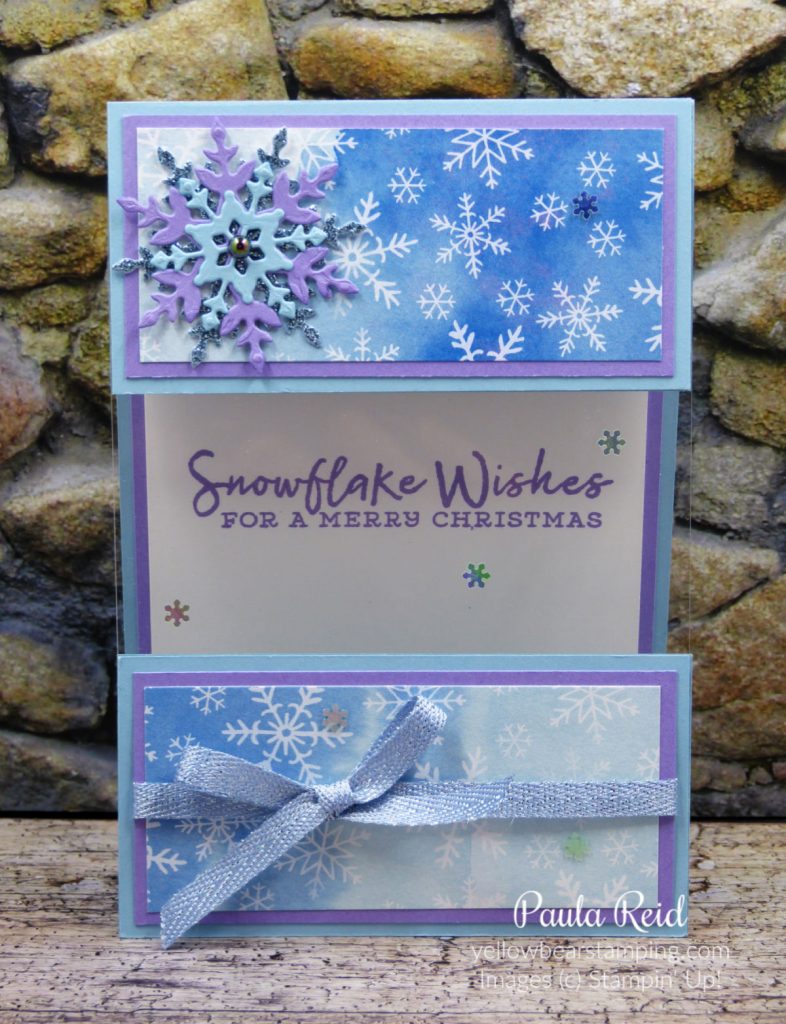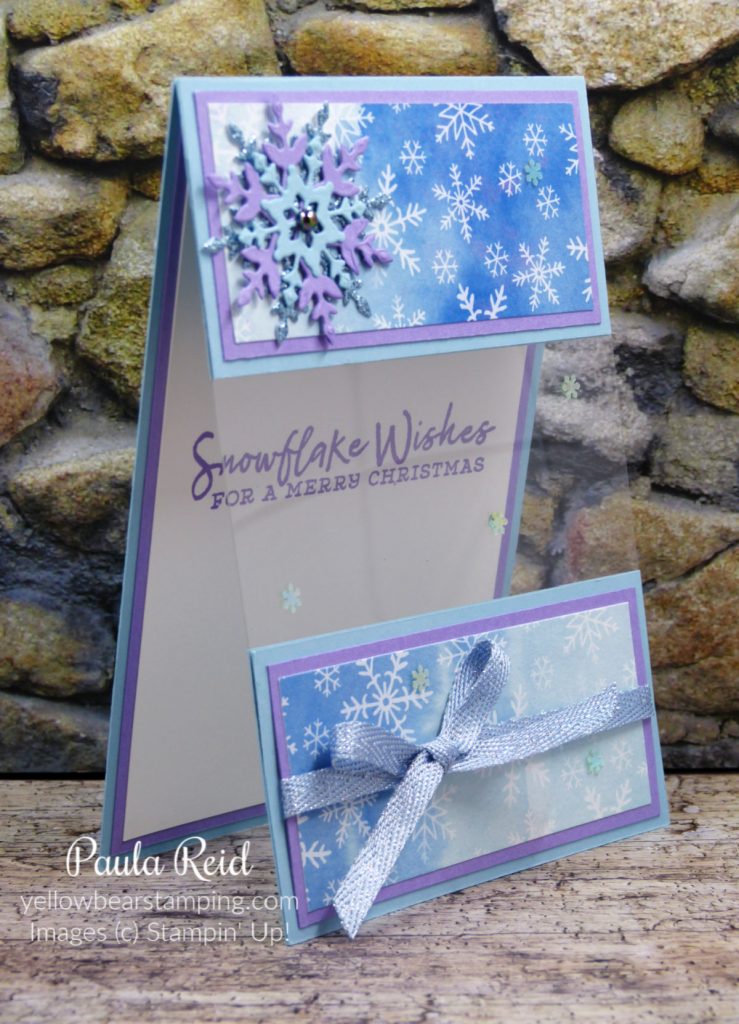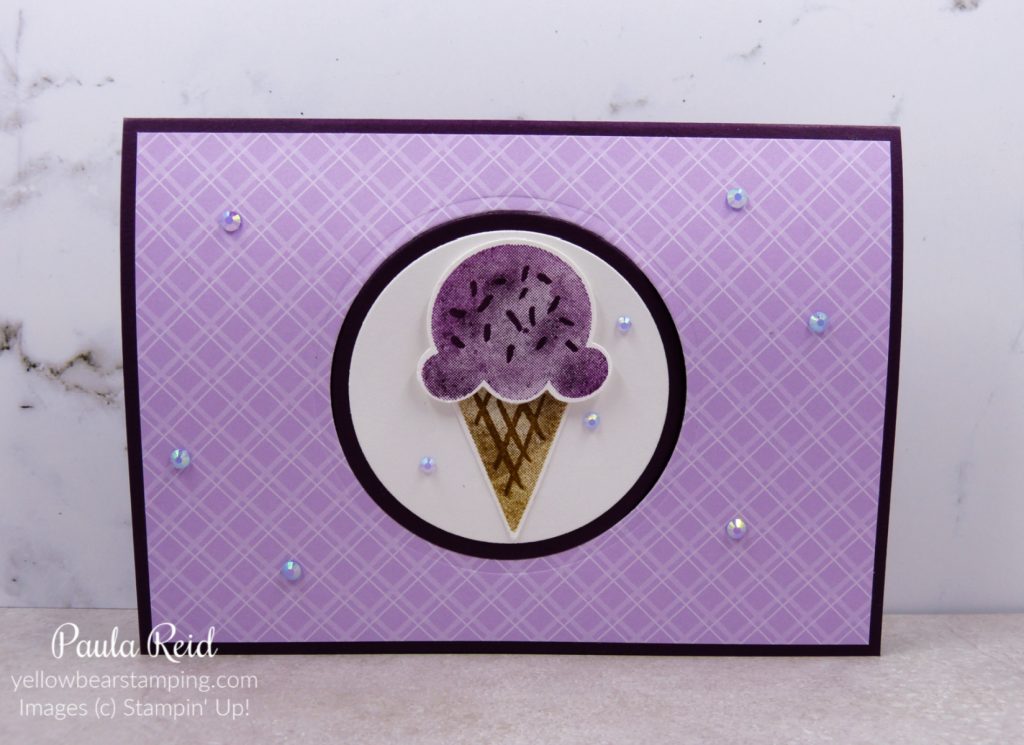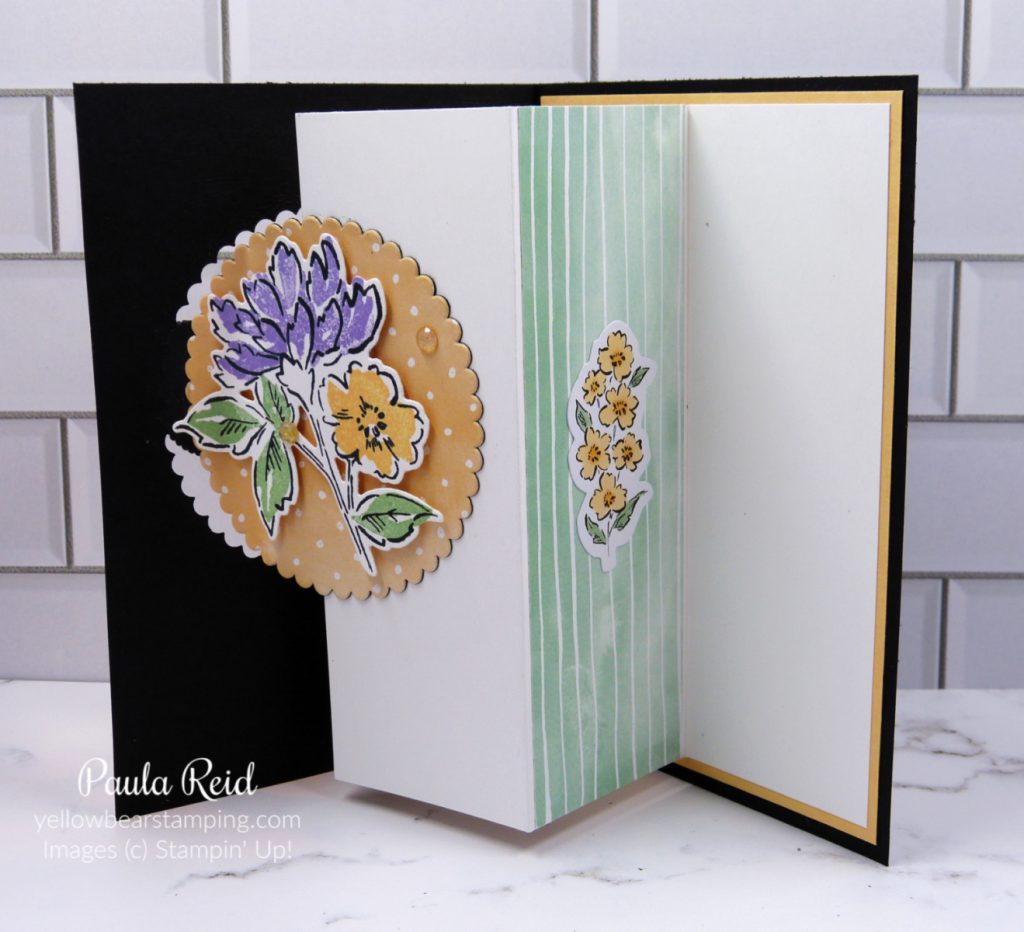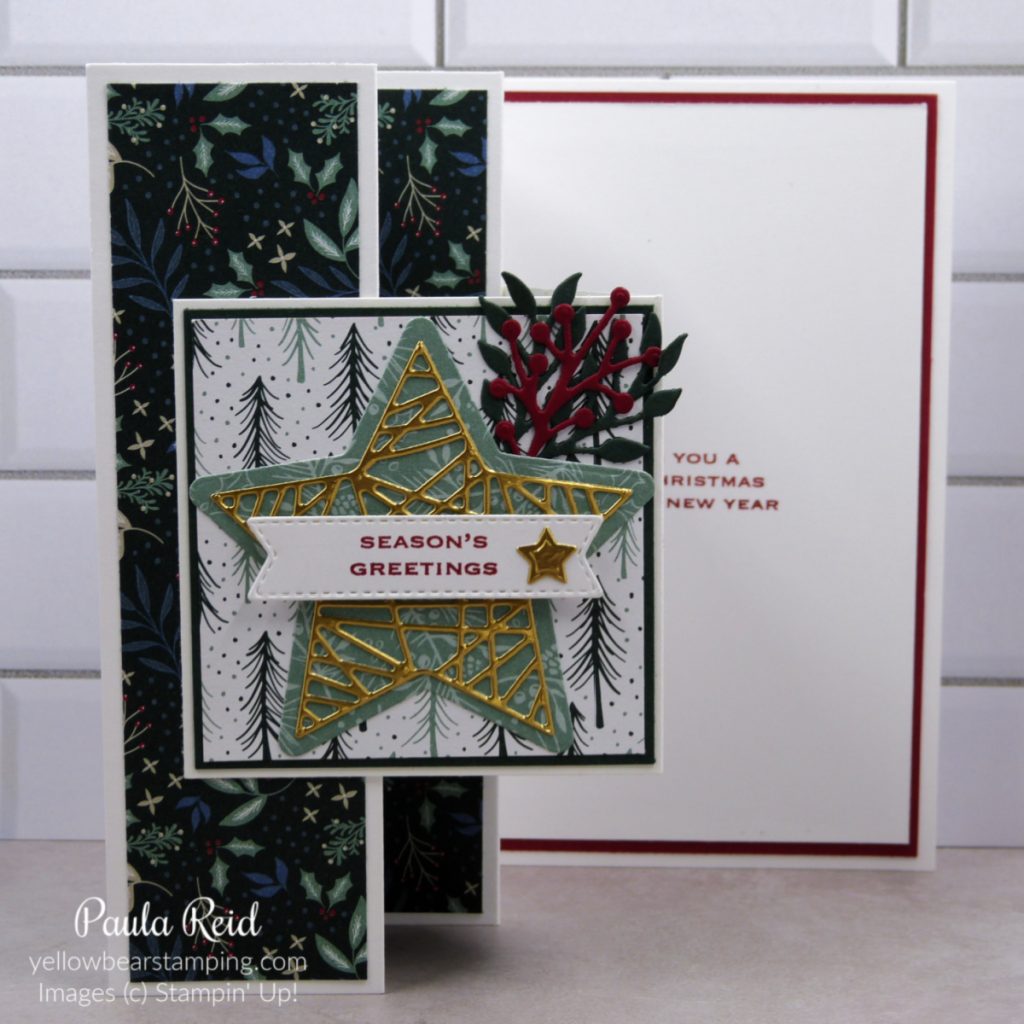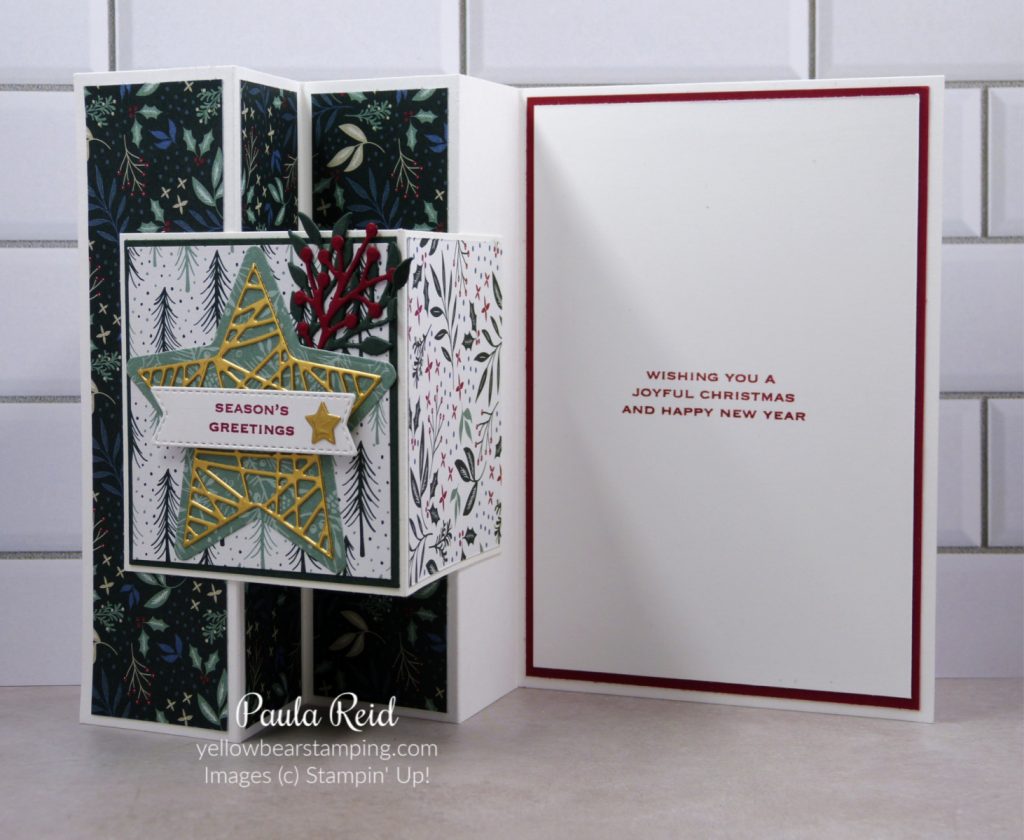
No – this is not a ‘car’ card but a card that has a ‘V’ and a ‘W’ fold in it. I CASEd this card from a US demo – Susan Campfield.
The card base measures 11 1/8″ x 14.8cm and is scored at 1 7/8, 3 1/2, 5 1/4 and 7″. When the card is folded shut it will measure a standard metric card of 10.5cm x 14.8cm. The front panel measure 7.5cm x 15cm and is scored at 7.5cm
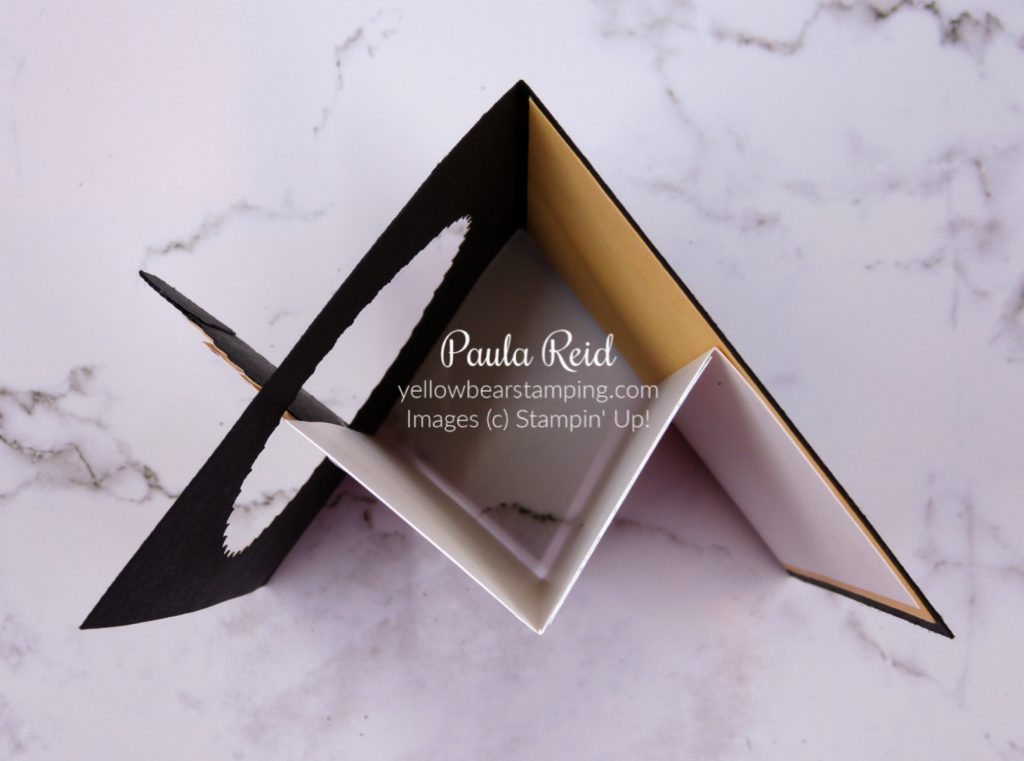
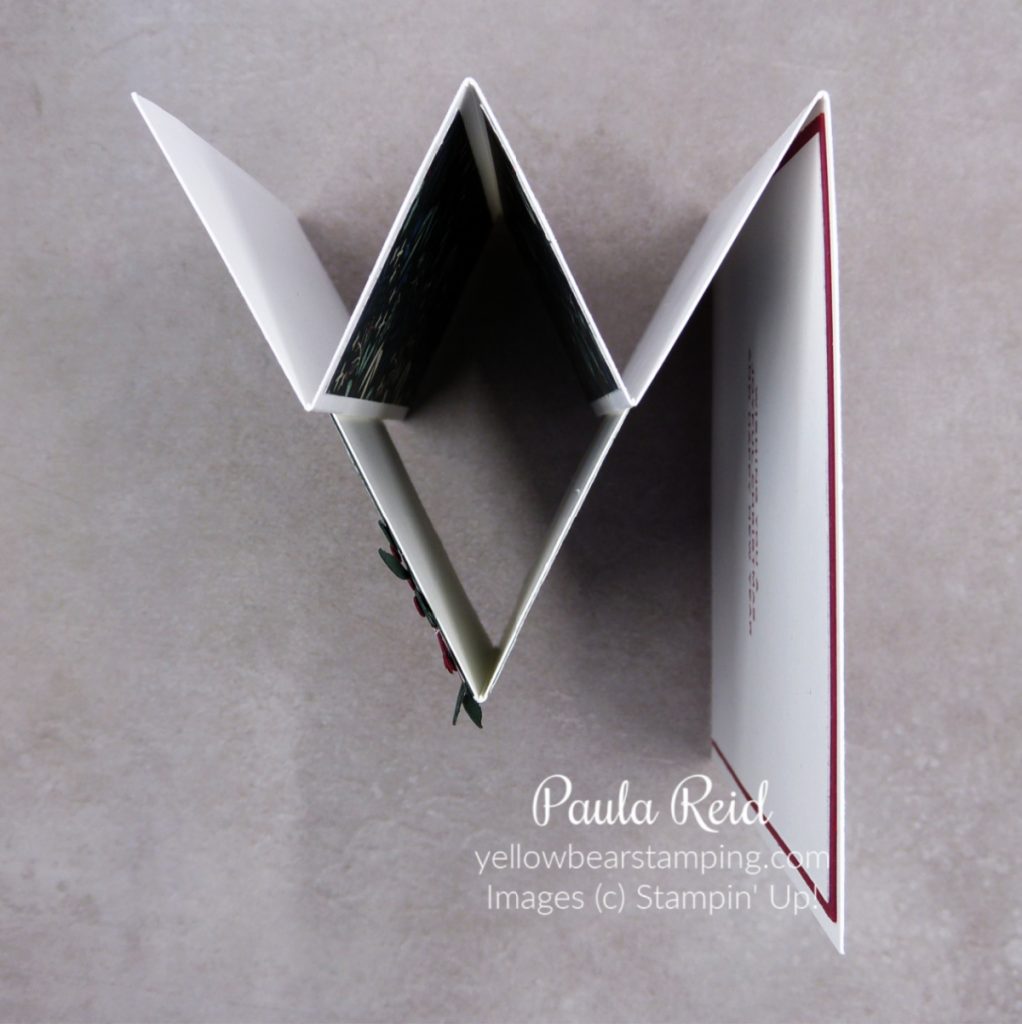
From the top view you can see why it’s called a ‘VW’ fun fold.
I’ve used the Tidings of Christmas Suite for this card – stamp, dies and Designer Series Paper (DSP). The DSP strips measure 1 1/2″ x 14.3cm and the square for the front is 7cm with a mat of Evening Evergreen measuring 7.2cm.
I really like this card design and plan to use it again to showcase some of the new products in the upcoming January to July Mini catalogue.
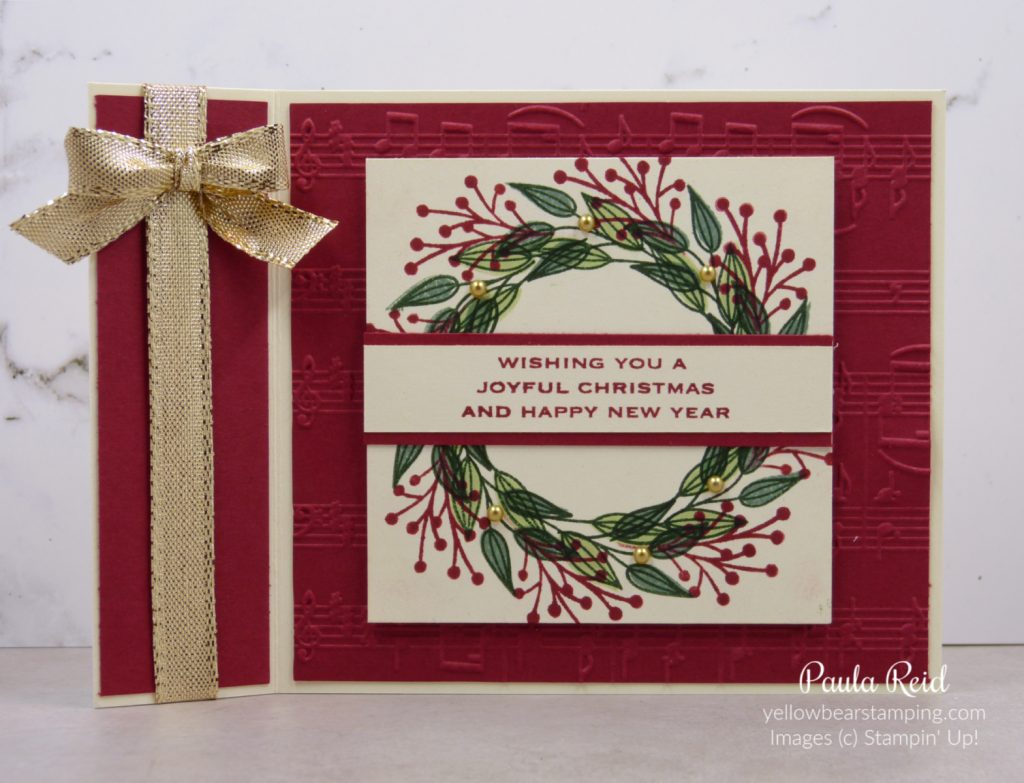
For today’s card I used a very useful tool – the Stamparatus – to help me create my stamped circle image. The Stamparatus is a stamp positioning tool and can be used for a number of techniques too.
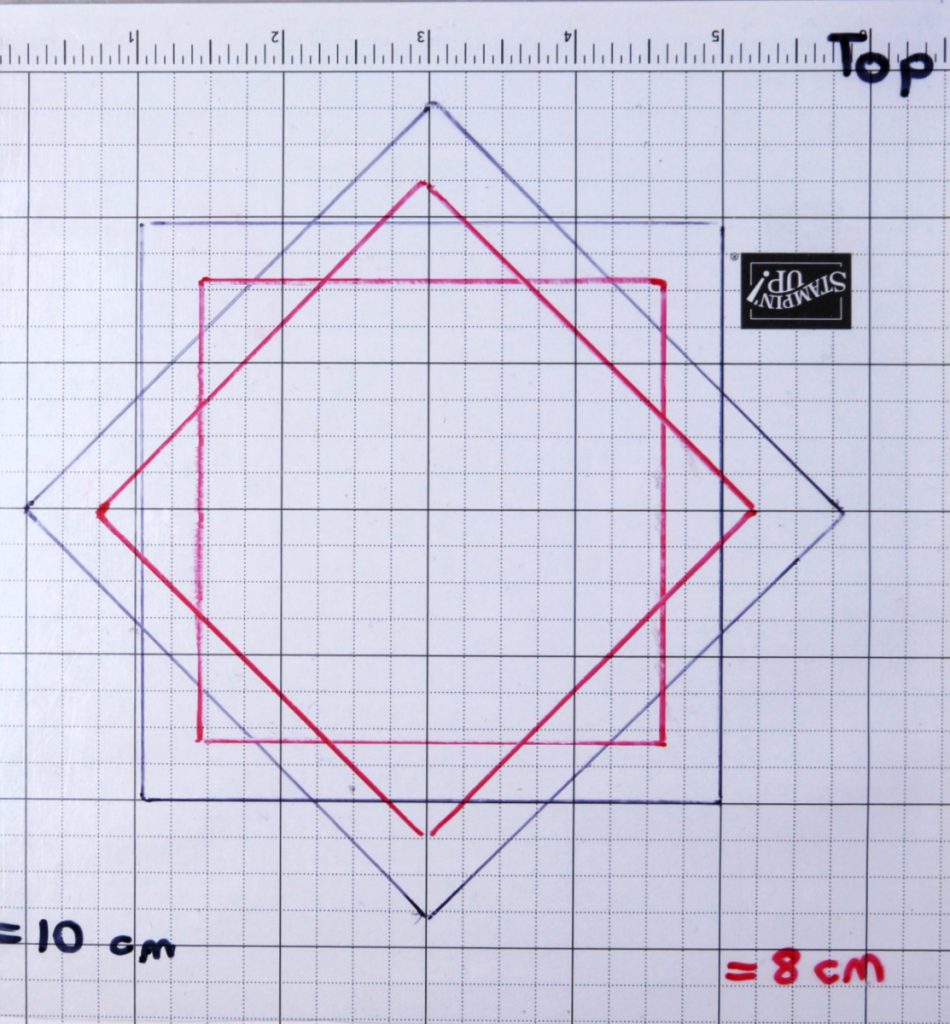
I’ve been wanting to use this technique for some time and the Tidings & Trimmings set was perfect to create a wreath. You’ll need a square of cardstock (mine is 8cm square), a template (as per below), your Stamparatus and your chosen stamp/ink.
Place your square so that it is centered on the grid paper and draw around the edge then turn it 45 deg so that the corners of the square are now on the vertical and horizontal central lines of the grid paper and draw around the edge.
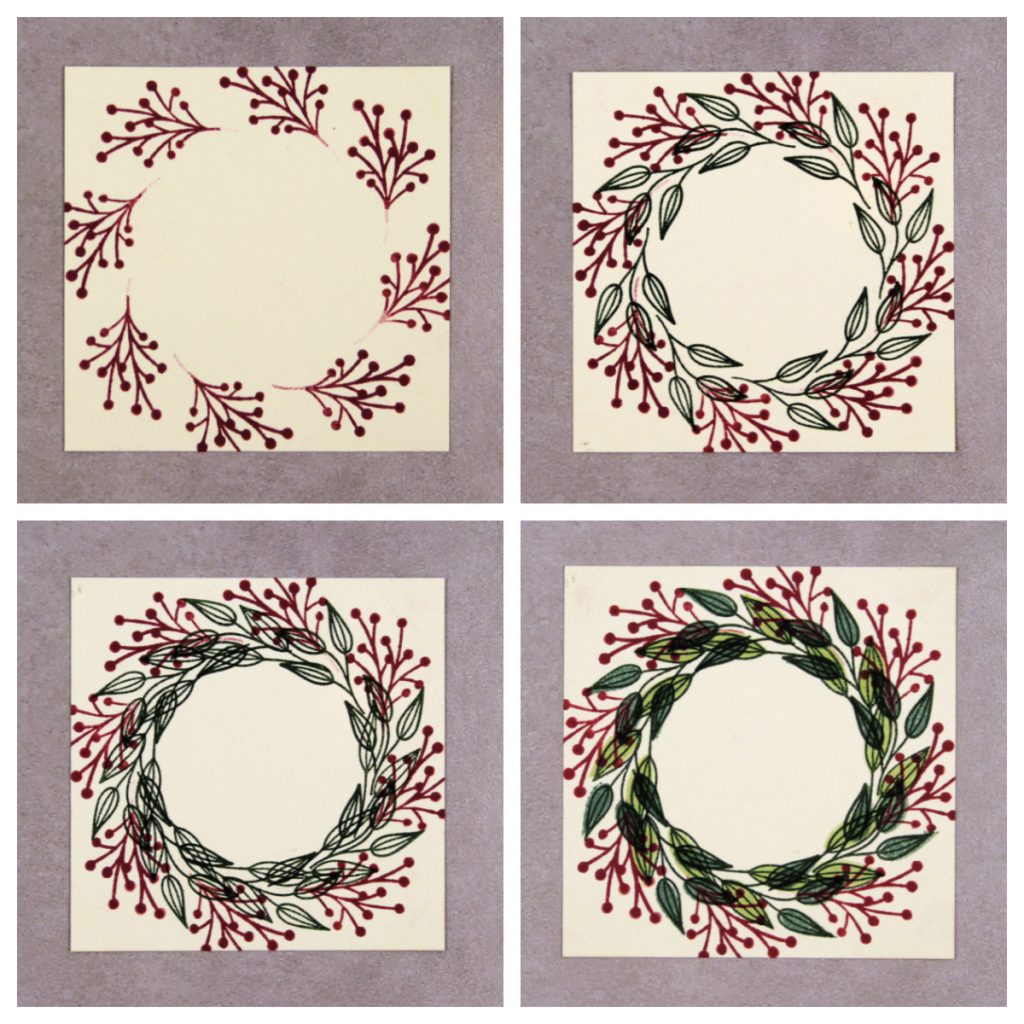
Place the template and the cardstock (in the square position rather than the diamond) in your Stamparatus. Stamp your first image then rotate the cardstock one position to the left and stamp again. Repeat this until you have the first circle (first photo below). Change your stamp and repeat as many times as needed until you create your circle/wreath image.
For my first image I didn’t fully ink up the stamp so that the stem stayed within the wreath. My second and third stamps are stamped in Evening Evergreen to create the base of the wreath. I then stamped the solid stamp in Soft Succulent and Soft Sea Foam to colour in the leaves.
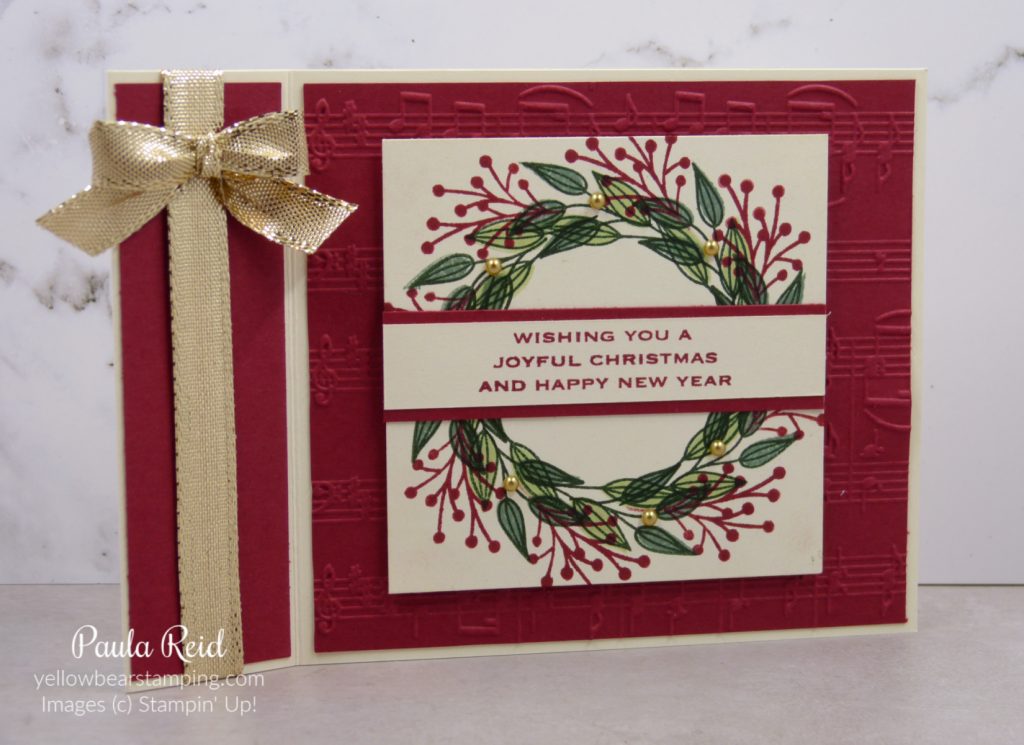
And the finished card – my favourite fun fold. The background has been dry embossed using the Merry Melody 3D Embossing Folder – I’m loving this folder. Instead of ‘bling’ I used the Metallic Gold Pearls to add some dimension to the wreath.
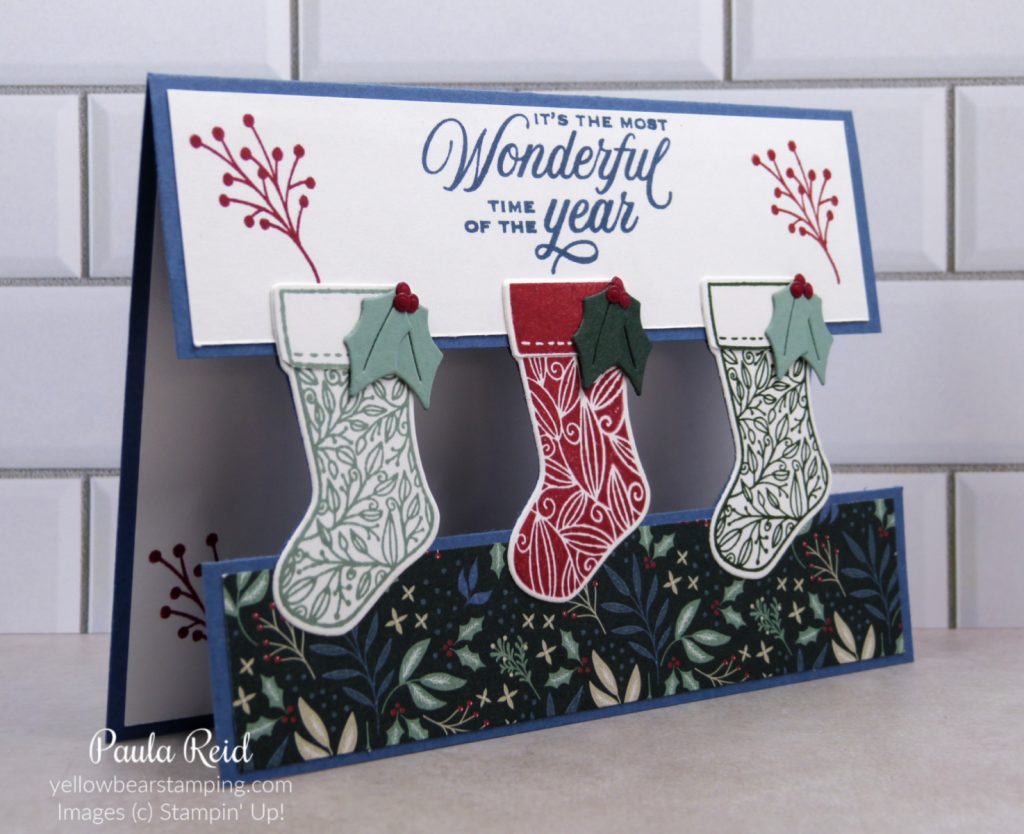
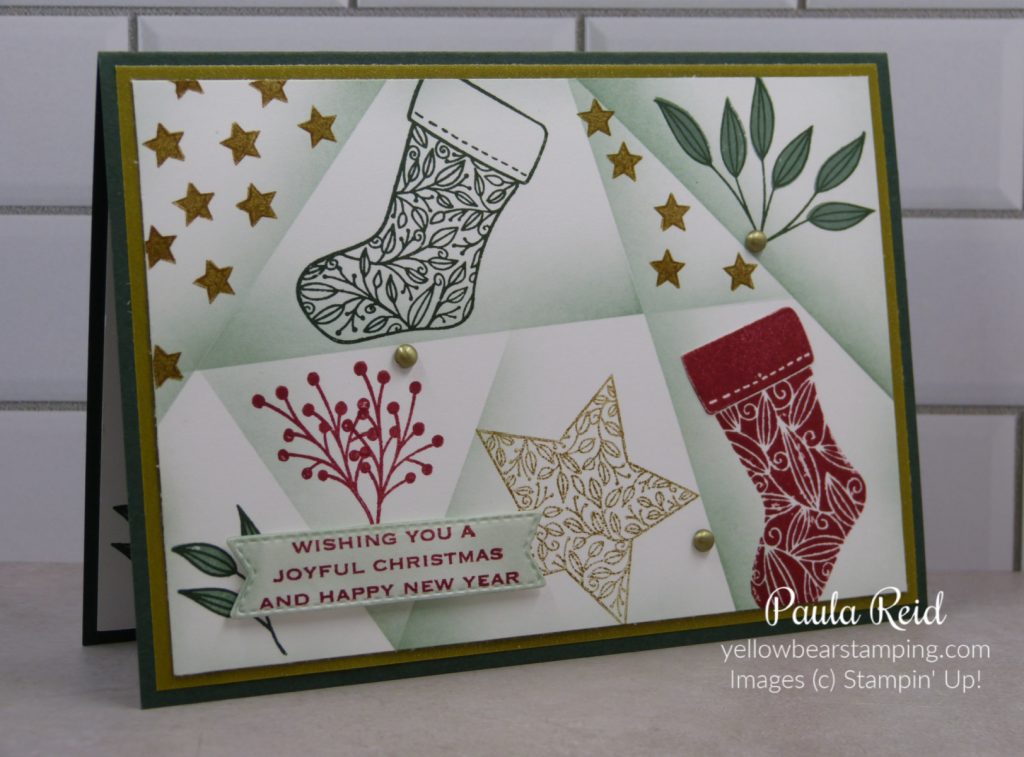
Today’s fun fold is a card design I first made way back in 2014 and have CASEd it a number of times since for Christmas cards – check out my 2019 version here.
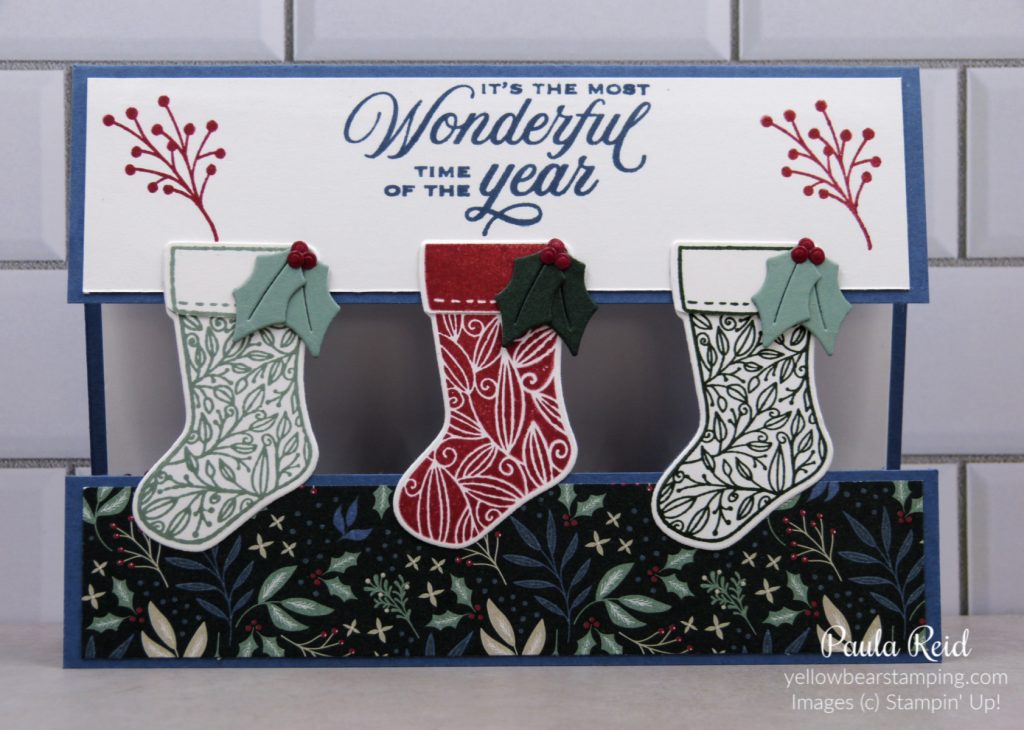
For this years design I’ve used the Tidings of Christmas Suite from page 88-89 of the Annual Catalogue. This suite uses three of our 10 In Colours – Soft Succulent, Evening Evergreen and Misty Moonlight.
To give the stockings a bit more dimension I stamped the ‘cuff’ of the stockings a second time, fussy cut them and then adhered on top of the original stamped image. The berries are rather tiny so to make adhering them easier I used some Adhesive Sheet on the back of the cardstock before die cutting them.
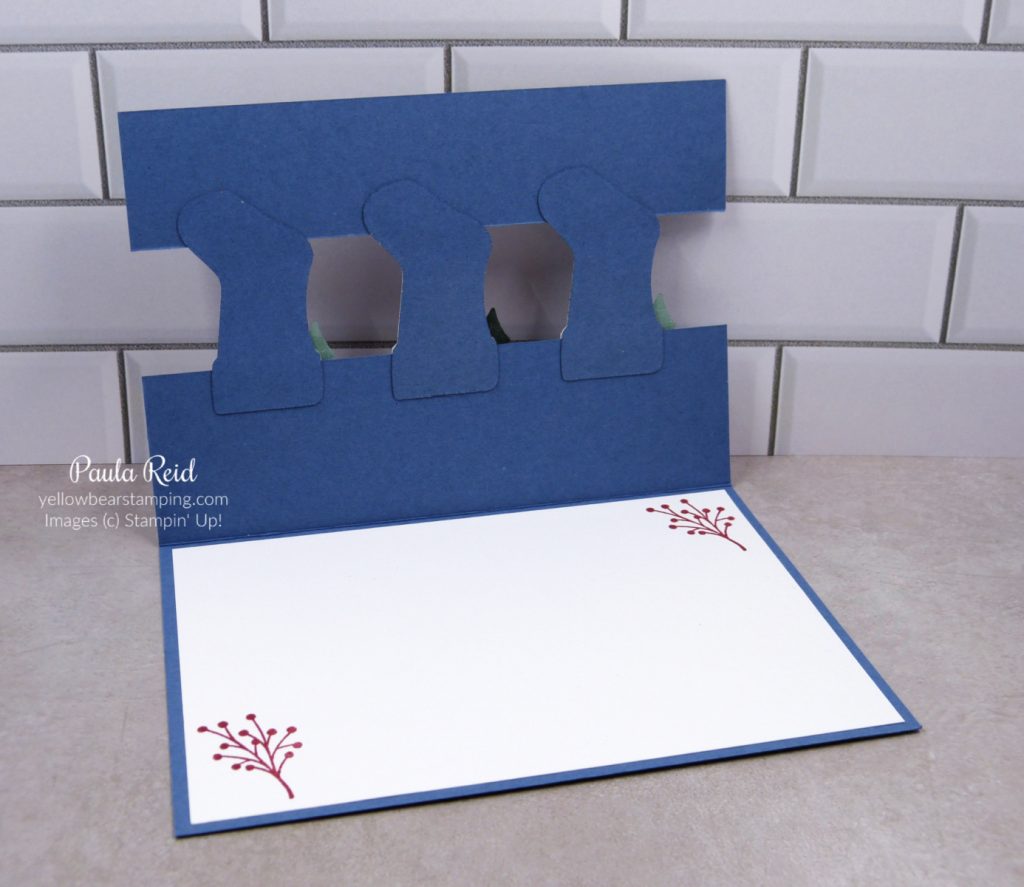
To strengthen the stamped stockings, I die cut additional stockings and adhered them to the back. If you had used an image that had been coloured in with Stampin Blends having a backing would also help to cover up the ‘bleed’ the shows through.
Even though I seem to use this card design for Christmas images you could use any stamp or die cut to achieve the same look.
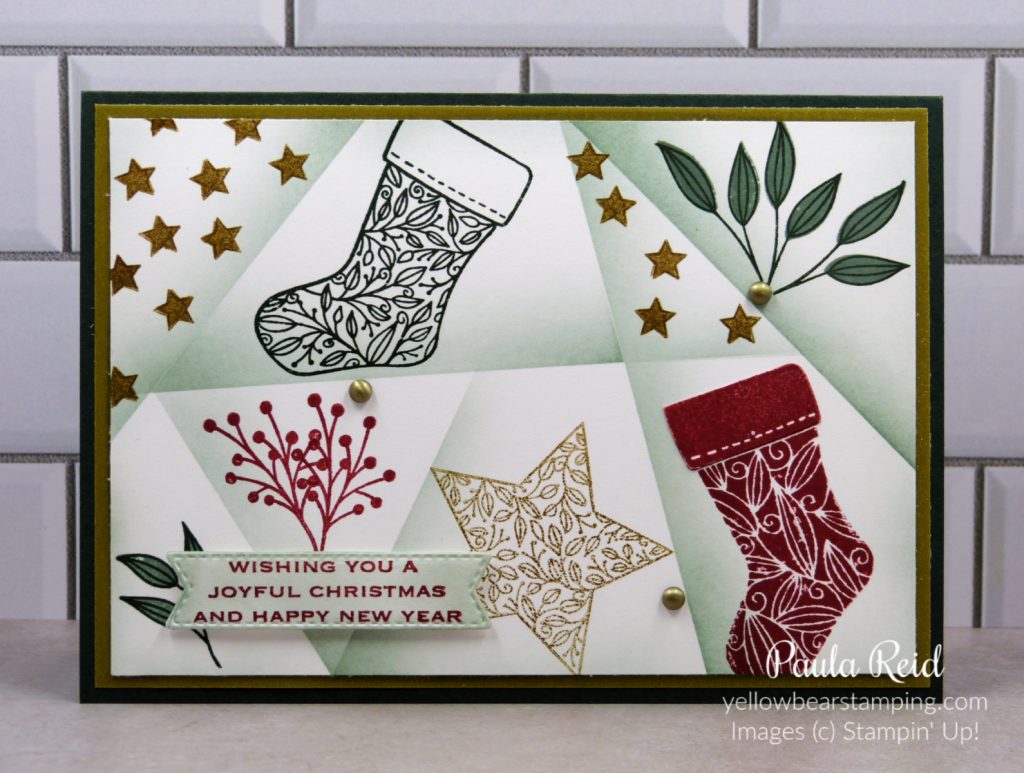
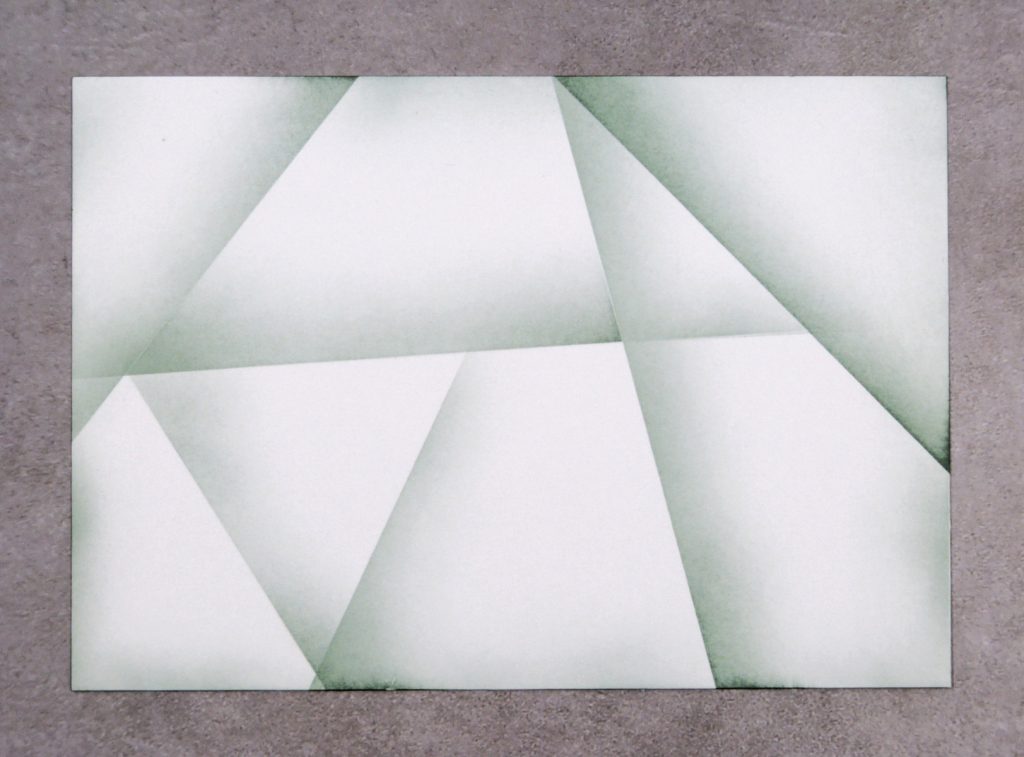
I tried this technique a couple of years ago and wasn’t happy with the end result (I think it ended up in ‘file 13’) so I thought I’d give it another go and I’m happy with how this one turned out. Retiform is simply the crossing of lines across the cardstock.
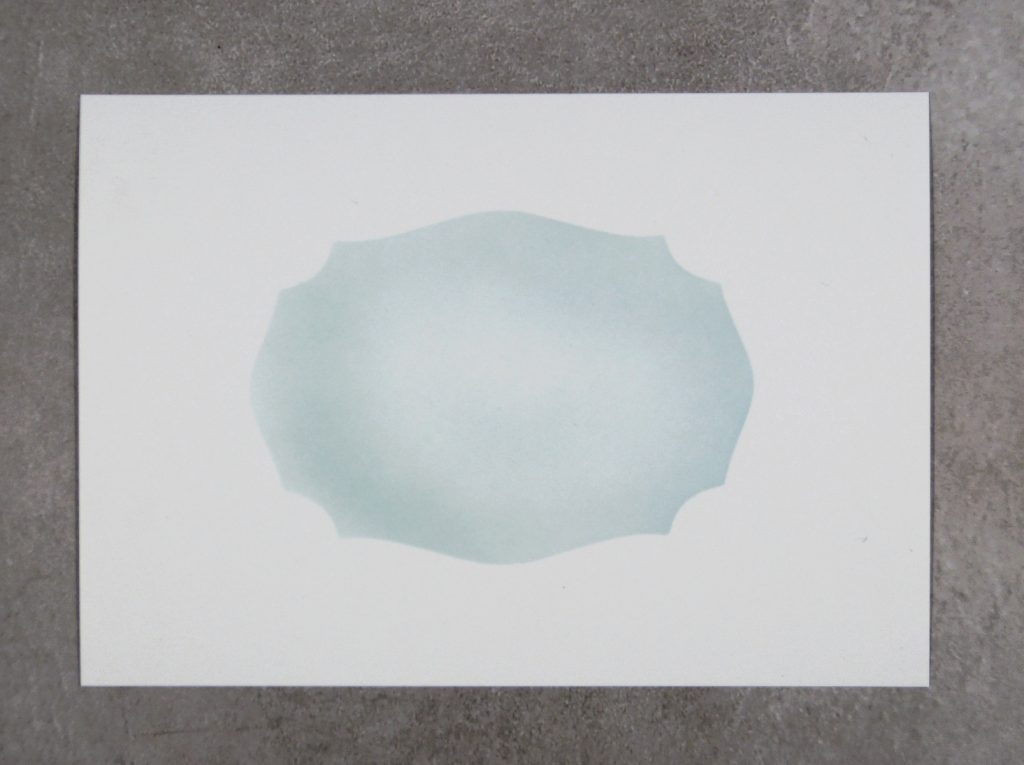
To create the ‘base’ you’ll need ink, a blending brush and Post-It Notes (I used long ones).
Use a Post-It Note to mask off a section of the cardstock that you want to colour first. Starting off the page, lightly apply ink – I used Soft Succulent – with your blending brush to the section. I made mine darker at the edge where the Post-It Note meets the cardstock. Move your Post-It Note to create a new section adjusting the angle of the line. Apply ink with your blending brush and keep repeating this until your cardstock is divided up into sections. You can have as many or as few sections as you want.
I selected Tidings & Trimmings as my stamp set as it has it had a good number of individual stamps that would fit into my sections without going over the lines. It also meant I could use all the images on the card. If you select a set that has bigger images than your sections you will just need to mask off the sections so that you only get a partial stamped image. I will give that a go next time.
I hope you give this technique a try too. Remember – if your first attempt at a new technique doesn’t turn out how you want it to, don’t give up – give it another go. Also if you get stuck on a technique or fun fold get in touch with me – I’m here to help.
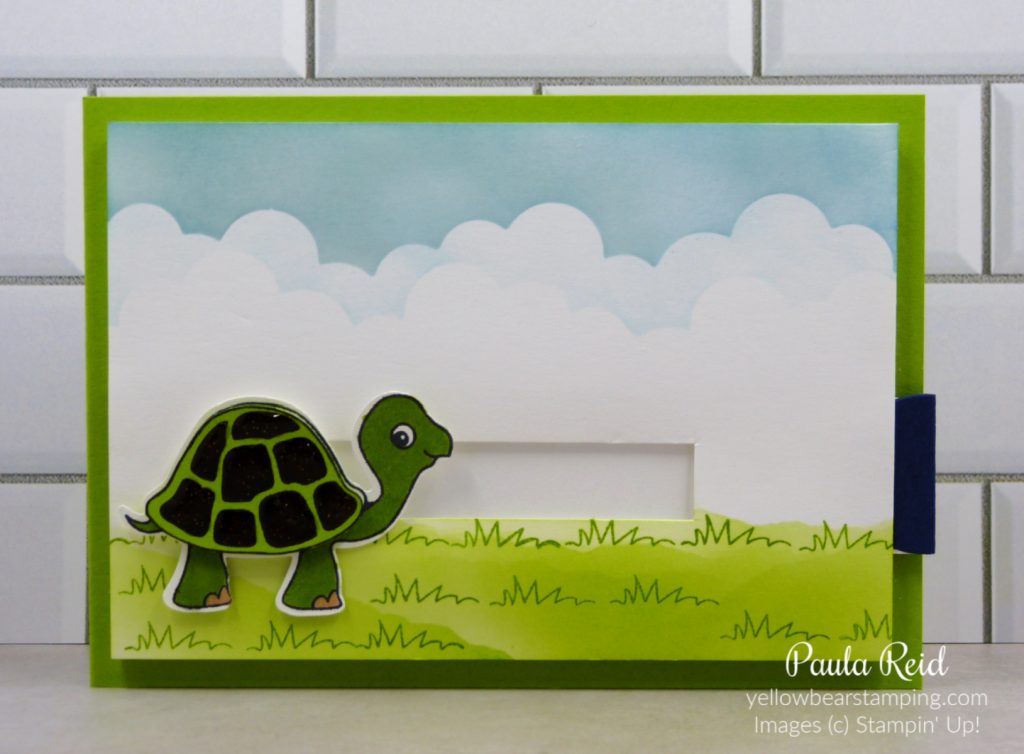
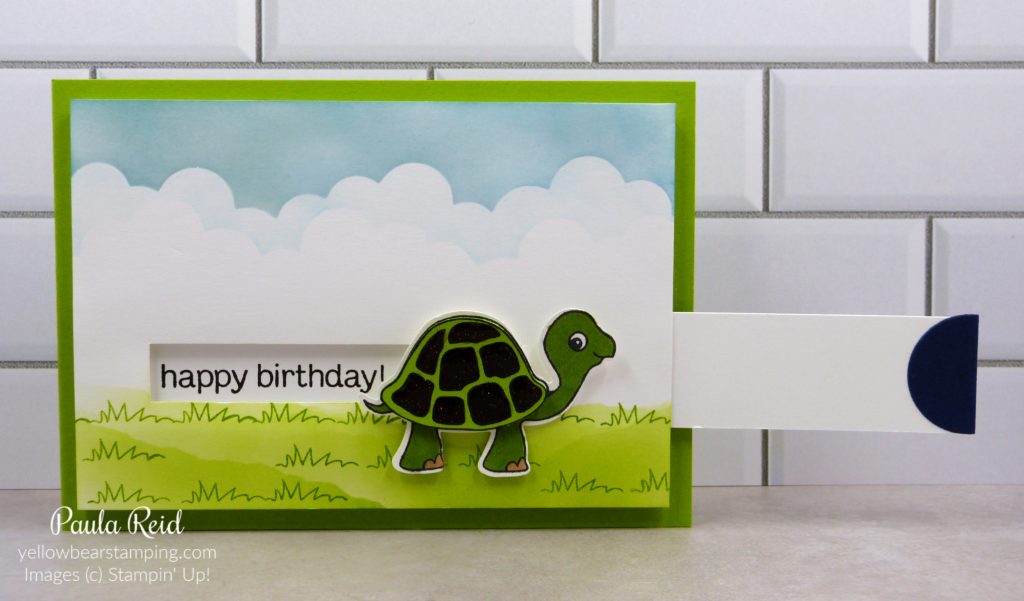
Today’s card is a fun interactive card and I’ve teamed it with a fun set – Turtle Friends. I created one of these cards a couple of years ago with a masculine theme and decided to recreate it using current products. To create this card you’ll need your Paper Trimmer, Foam Adhesive Strips and Dimensionals.
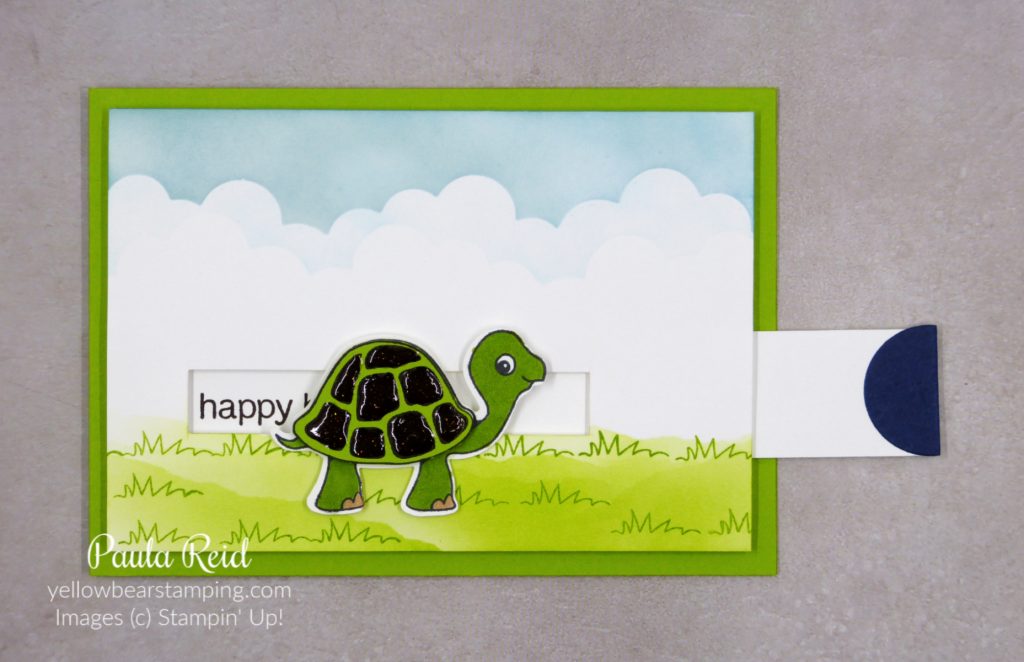
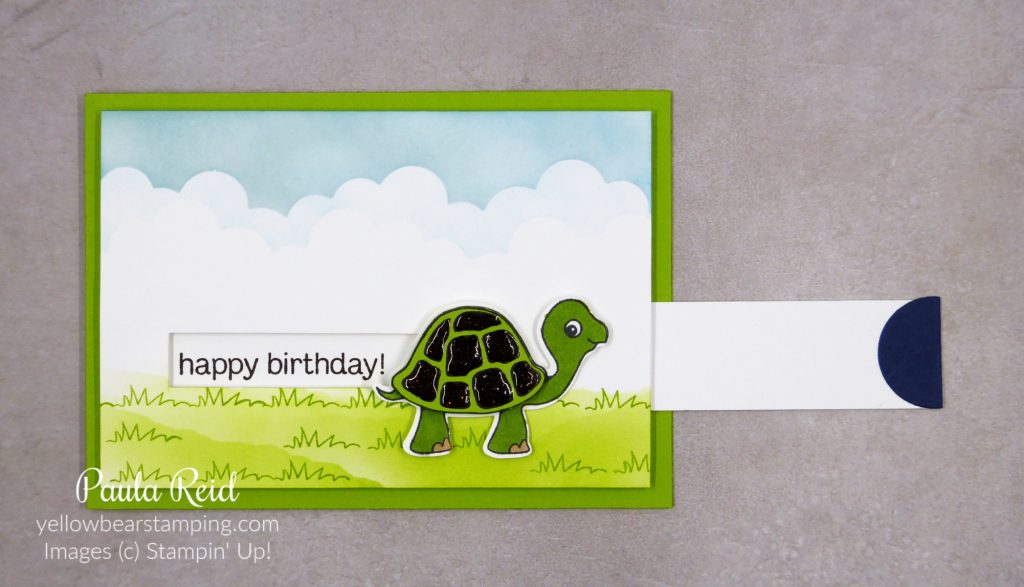
Isn’t he cute? Pull the tab on the right and Mr Turtle will slide across the card and reveal a hidden message.
Using my blending brushes I created the background and then cut out the slot. I should have taken a photo mid construction to show how the back of the card and slider mechanism works – oh well I will just have to create another card and do that step.
I already had Mr Turtle cut out on my desk but he was a different colour so I gave him a new ‘paint job’ with the Granny Apple Green Stampin Blend so that he matched his shell (which was also on my desk).
The ‘happy birthday’ is stamped on a piece of cardstock and adhered to the card base. The card front is adhered with Foam Adhesive Strips – make sure you add these to your next order as they are great for a number of projects.
I hope you’ve enjoyed this card and keep an eye out for another version soon.
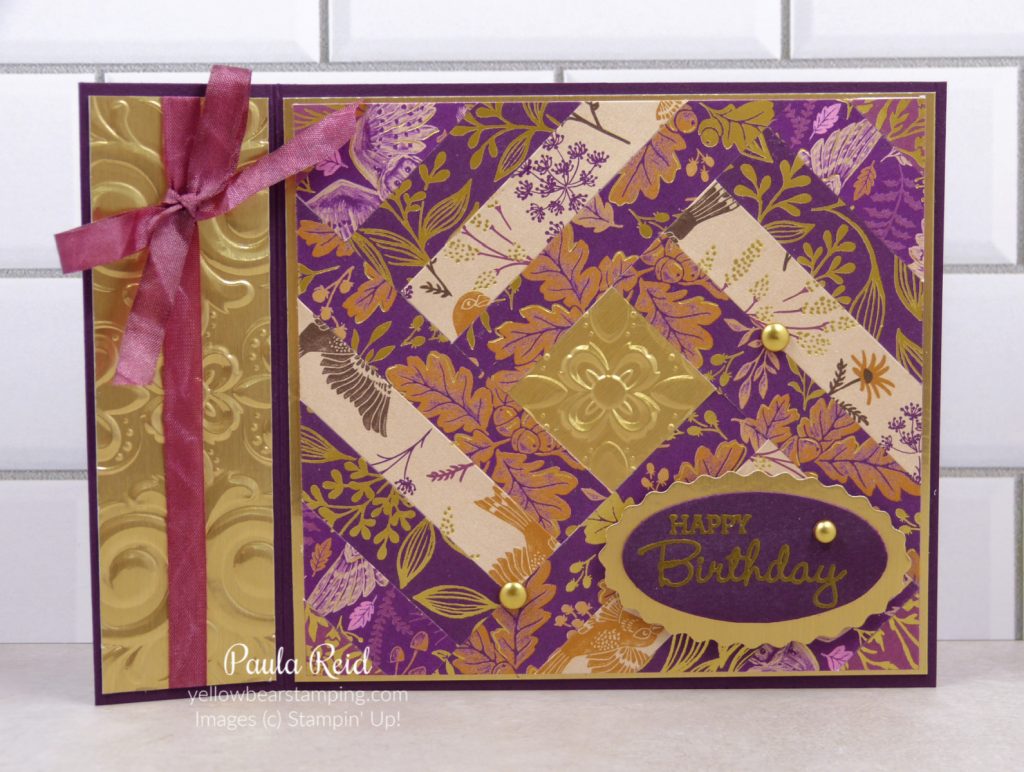
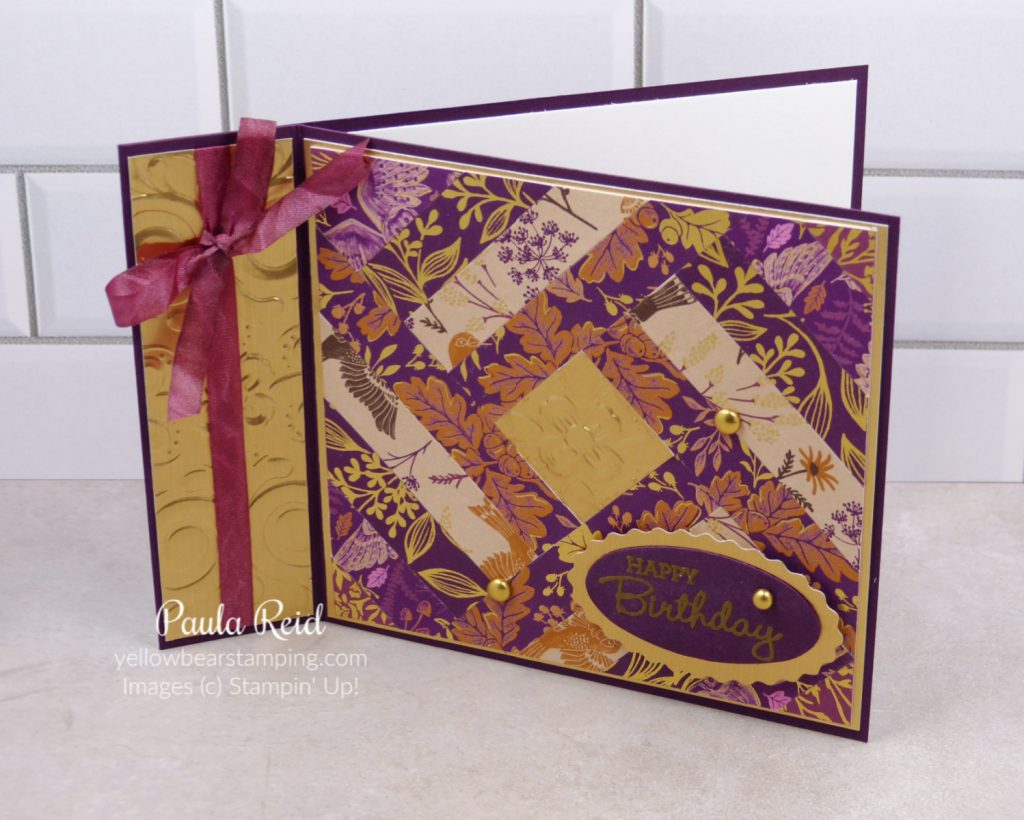
Quilting is normally associated with fabric but we can achieve the same effect with our Designer Series Paper. Today’s card is a CASE from US demo Lisa Henderson. I’ve had this technique on my list for some time and after seeing her card it inspired me to make it too. I’ve used the Blackberry Beauty DSP and combined it one of my favourite ‘go to’ fun folds.
Yes – it’s the Book Fold – check out my earlier post on how I make these cards. This paper is gorgeous with the hint of gold (although I’ve found it hard to get my photos to the true colour) and even though we’re not in Autumn here the ‘leaf’ theme of the paper works for any occasion.
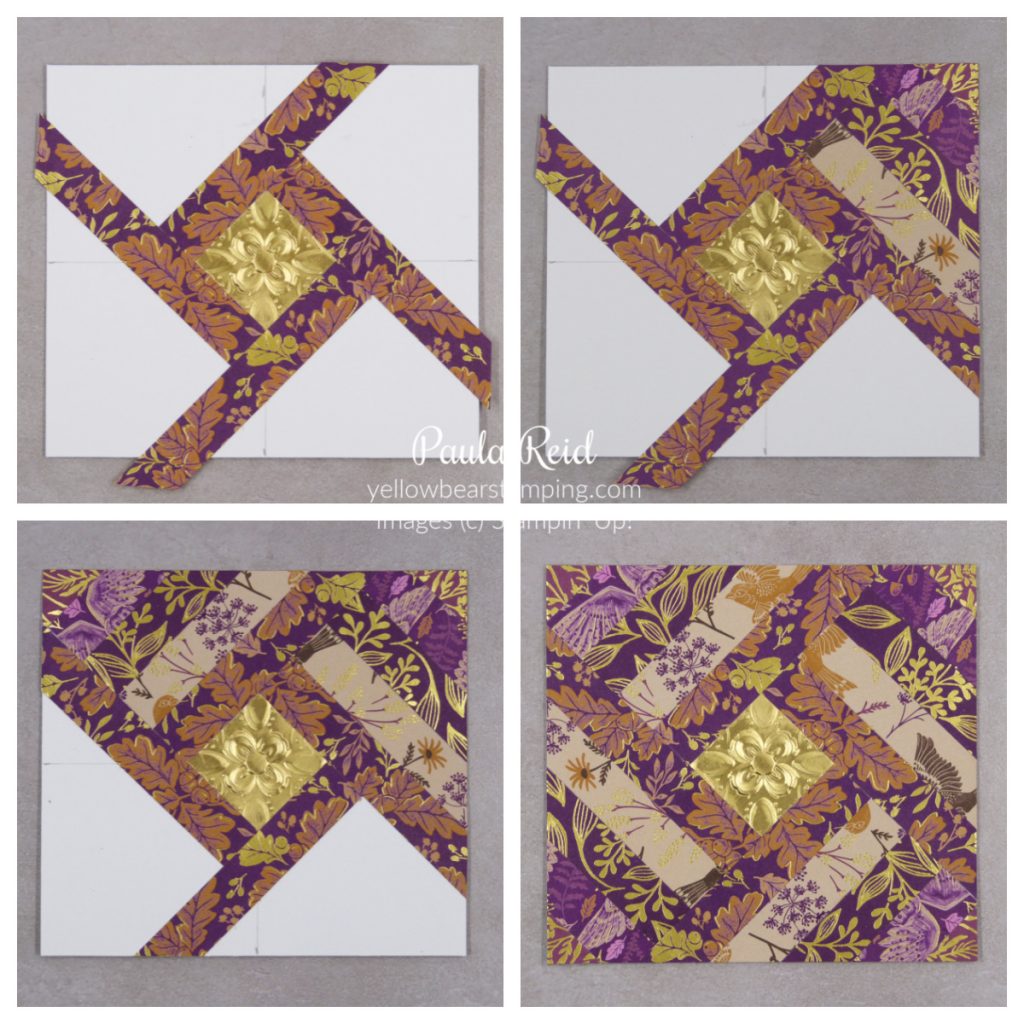
Below is a step by step of how I created my quilting. I started off with strips of DSP measuring 1/2″ x 12″ in 5 of the 6 designs.
Starting with a base of 11cm x 11cm I found the centre then adhered my Brushed Metallic Gold 1″ square (which I had dry embossed) lining up the corners of the square with the vertical and horizontal lines. Adhere down your first strip of DSP trimming as you go. Take your second patterned strip and adhere hard up against the existing strips. Repeat with your remaining strips until the section is complete. Repeat until all sections are filled. I then trimmer my square to fit my card front. I matted it on a piece of Brushed Metallic Gold.
Don’t forget the Seasonal Sale started today – check out my Promotions page for more details. If you would like to place an order you can do so via my online store or contact me directly. I will be placing an order tomorrow night (Wednesday 17th).
Fold, snip, layer, and stamp! During the Seasonal Sale, you can stock up and save 10% on cardstock, 15% on ink pads, and 20% on dies. Build up your collection of crafting basics—and prepare for another year of top-tier projects—with a steal of a deal on papercrafting products! Check out my Promotions page to find out which items are included in the sale. You can place an order via my online store or contact me directly.
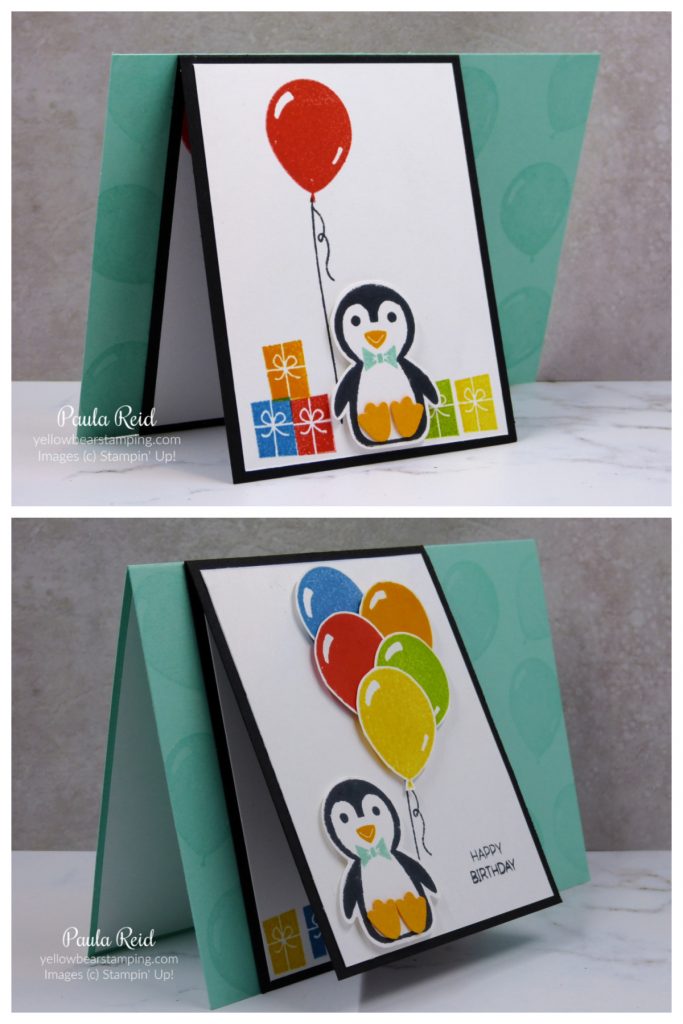
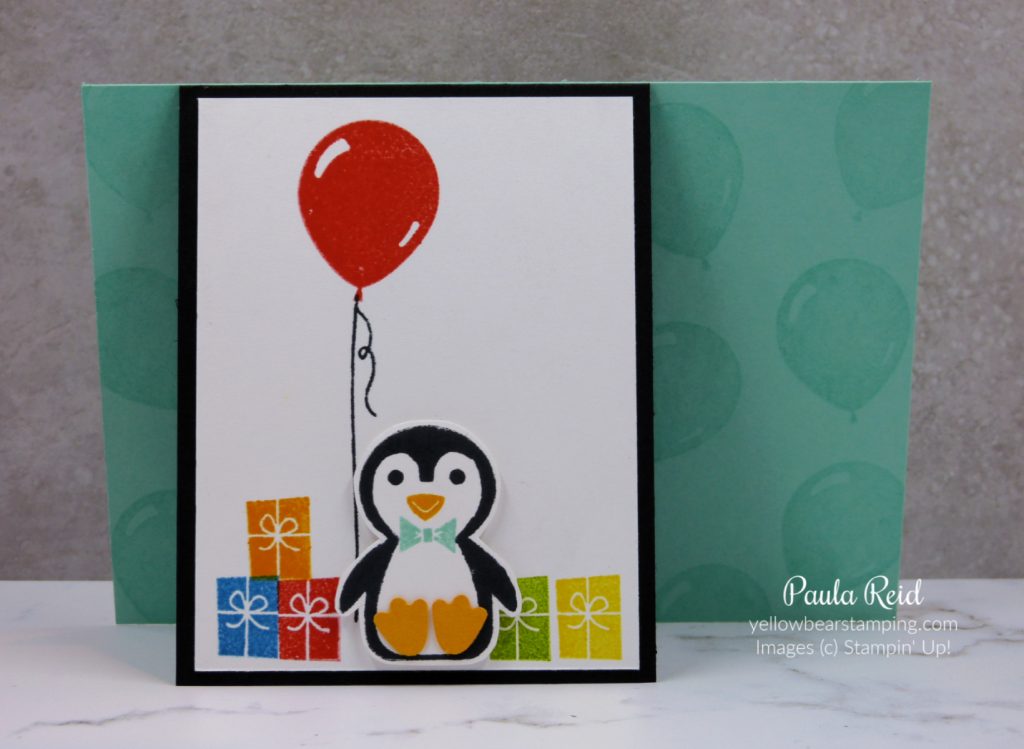
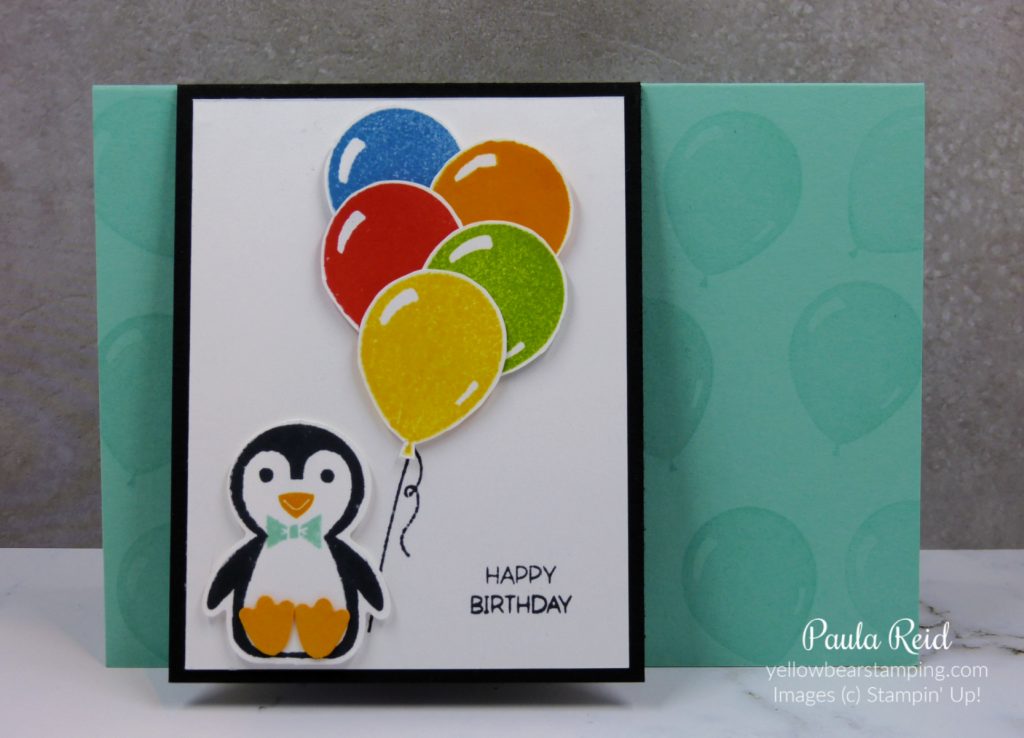
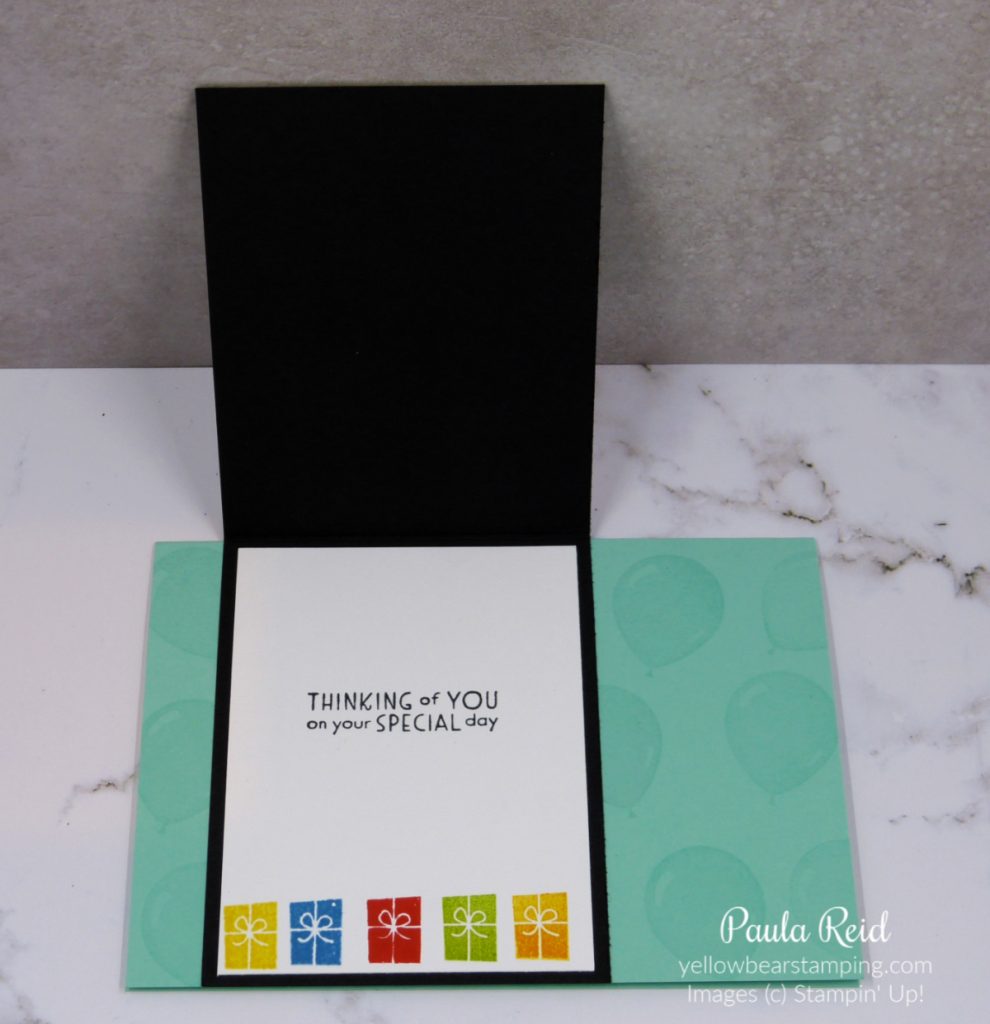
I first shared a Front Flap card back in 2018 and then again in 2019 and today I’ve got two variations of this design – a Single Front Flap and Double Front Flap. Most Front Flap cards are of the ‘single’ variety. The ‘flap’ is adhered to a card front rather than a full card base. For my ‘double’ version I’ve adhered the flap to a standard card base hence the ‘double’.
Isn’t the Penguin cute? He’s part of the Penguin Place Bundle from page 33 of the July-December Mini Catalogue. The bundle consists of the Penguin Place stamp set and then Penguin Builder Punch.
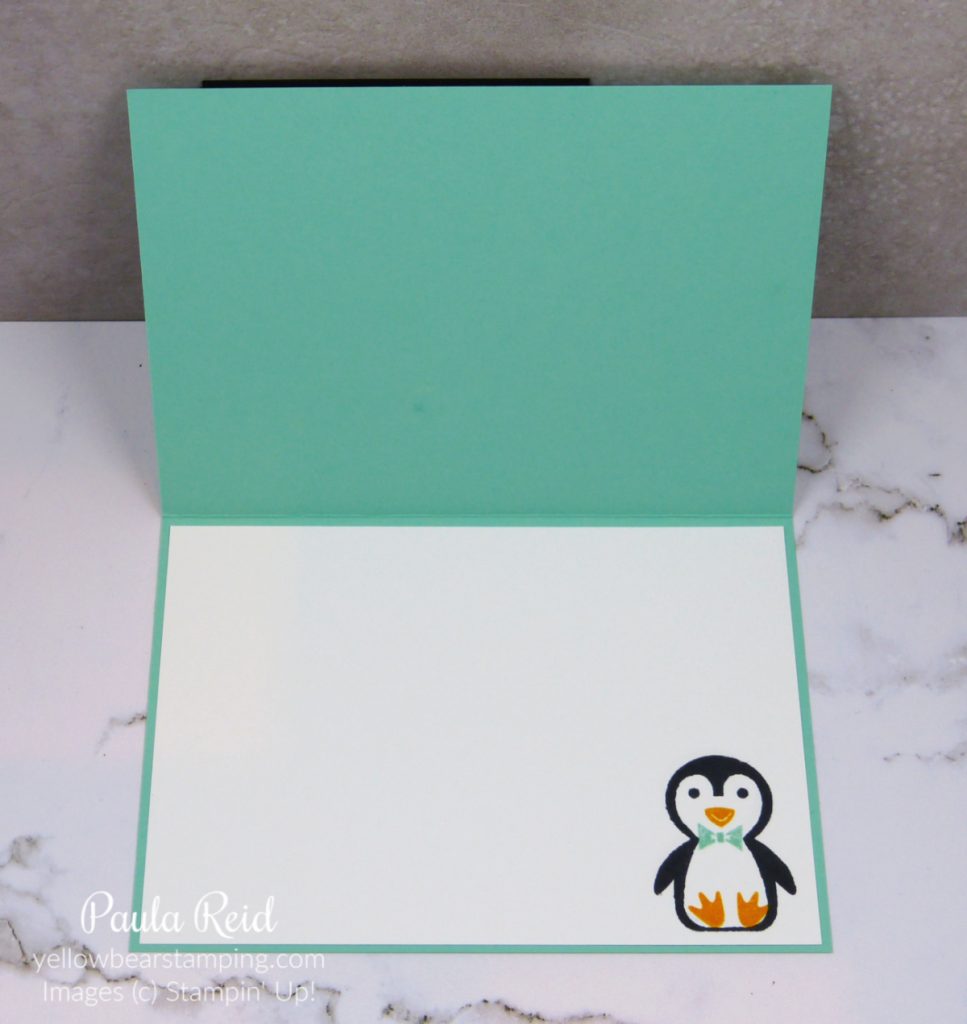
Mr Penguin is stamped in Memento Black ink with his nose and feet stamped/punched with Mango Melody. His bow tie is Coastal Cabana to match the card base. There are 28 stamps in this set including birthday and Christmas themed sentiments and accessories. For those of us in the Southern Hemisphere we could also use the images for winter themed cards.
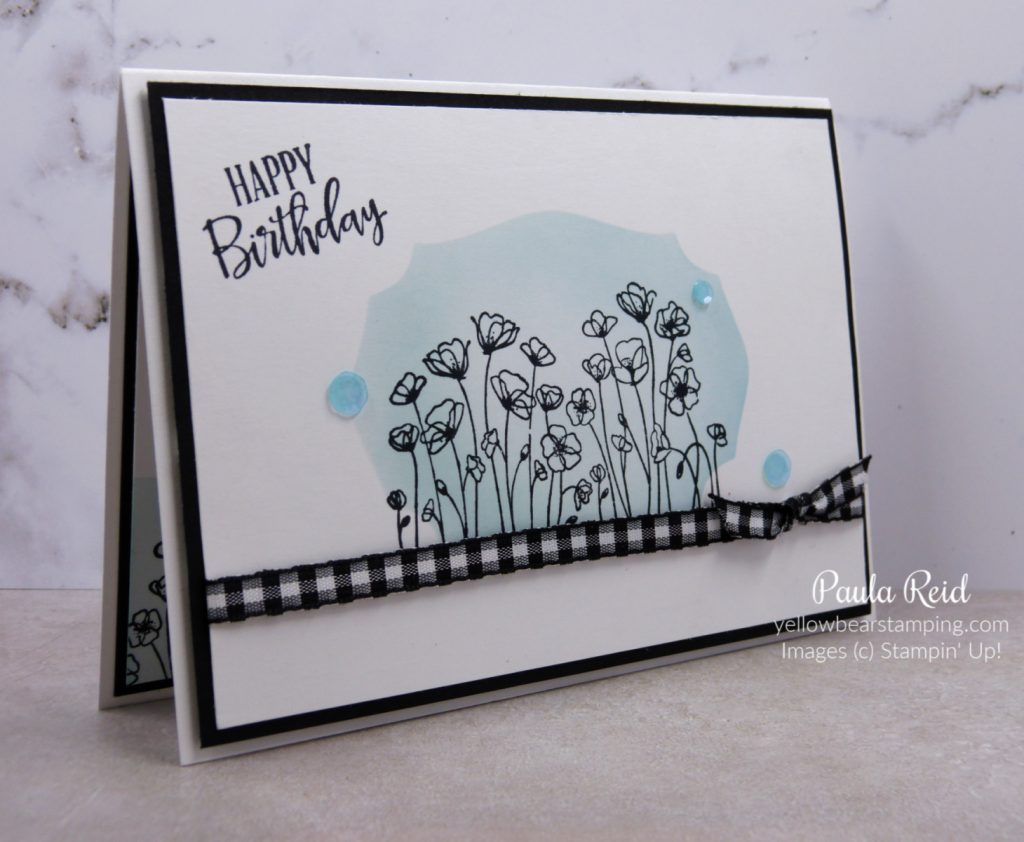
As an alternative to using Designer Series Paper (DSP) or dry embossing your card base you can stamp an image using VersaMark and it will pick up the colour of the card base.
For my double flap card I stamped the balloon image in Pacific Point, Mango Melody, Poppy Parade, Granny Apple Green and Daffodil Delight then ‘fussy’ cut them out. The back two balloons have been adhered with dimensionals and then the others have been adhered with ‘snail’ on top of each other.
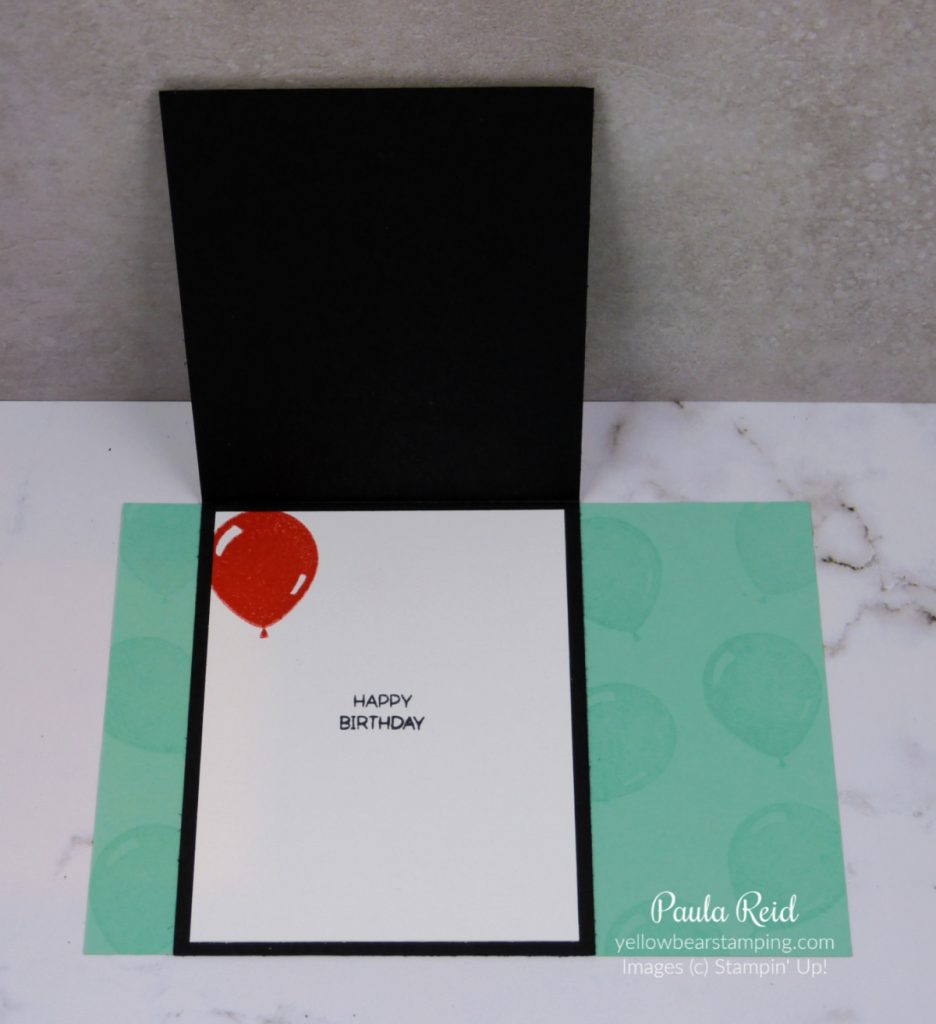
And here’s the inside of the first flap – I’m not planning on writing anything on this layer. The flap for both cards measure the same – 8.2cm x 21cm (scored at 10.5cm) and the Basic White panels measure 7.6cm x 10cm.
And finally the inside of the card – this is where I’ll write my birthday message. This Mr Penguin is fully stamped directly onto the Basic White insert.
I had fun making these cards – my first ones using the Penguin Bundle. I’m hoping this bundle will carry over to the next catalogue as he’s super cute.
Last week I shared a project we made at our online event – I now have the next instalment – a ‘one sheet wonder’. A ‘one sheet wonder’ is a technique used to create a number of cards from a sheet of Designer Series Paper (DSP) based on a template. You can also create your own DSP by stamping images on a sheet of Basic White or Very Vanilla cardstock. There are lots of templates available to use with 6″ x 6″ or 12″ x 12″ DSP. For our template of 6″ x 6″ we made four cards. Rather than starting with one sheet of DSP I decided I would use up some of my scraps of In Good Taste paper and matched my off cuts to the measurements for each of the four designs. This meant I could mix and match my DSP.
Here’s the template that I used – I’ve included metric and imperial measurements as sometimes I find it’s easier to work in inches even though I’ve grown up with centimeters.
The first cut is at 1 1/2″ and then the second cut is at 3″ giving you three strips. Trim the first strip down to 14.8cm. With the second strip (long side against your top ruler) cut at 3″ and then cut the remaining piece at 1″ intervals to give you three pieces. For the last strip (again with the long side at the top) cut the strip into 1 1/2″ pieces.
This template is for the mats – cut it up in a similar way to the DSP then match up the coordinating pieces of cardstock and DSP. I also like to add a card front mat rather than just adhering the DSP to the card base. For my card front mats I dry embossed them with either the Tasteful Textile 3D Embossing Folder or the Brick & Mortar 3D folder. As these were masculine cards I didn’t add too many embellishments. For Card A I found the little triangle cut outs on my desk and they were in the right colour scheme and then it’s just add a sentiment. You can change the orientation of the card base and placement of the DSP to get a different look from the same template.
I’m in need of more masculine birthday cards for work so I’ll be repeating this technique. I hope you give it a go – it’s great way to use your DSP and add more cards to your stash ready to send out.
I’ve been wanting to make a Corner Tuck card for some time and today’s the day it happened. I combined a couple of variations to create my Blackberry Beauty themed card.
The card gets it’s name as you need to ‘tuck’ the front panel under the ‘corner’ to close the card.
The corner panel is adhered to the base with dimensionals in each corner allowing the front panel to slip in underneath. I cut a 2 1/4″ square from cardstock and Designer Series Paper (DSP) and then cut them on the diagonal before adhering together. This will give the DSP some strength. I now have a left-over triangle to use on another card. To complete the card off I adhered three Brushed Metallic Adhesive -Backed Dots.
I started off with a card base of 10.5cm x 29.7cm – scored in half. I then cut off 9.5cm which was rotated and used for the front mat panel. I trimmed it down to 8cm x 10.5cm but I think next time I’ll cut off 8.5cm instead of the 9.5cm. The Basic White panel measures 7.5cm x 10cm and has had Cinnamon Cider ink applied with a blending brush so it’s not so stark. The sentiment is stamped in Rich Razzleberry to coordinate with the card base.
And I even used a small one on the inside. So apart from the sentiment there is no stamping on this card. From the inside you can see how the front panel is only partially adhered to the card base.
This was an easy card to make and with the corner tuck is quite effective – plus you can get two from one sheet of cardstock.
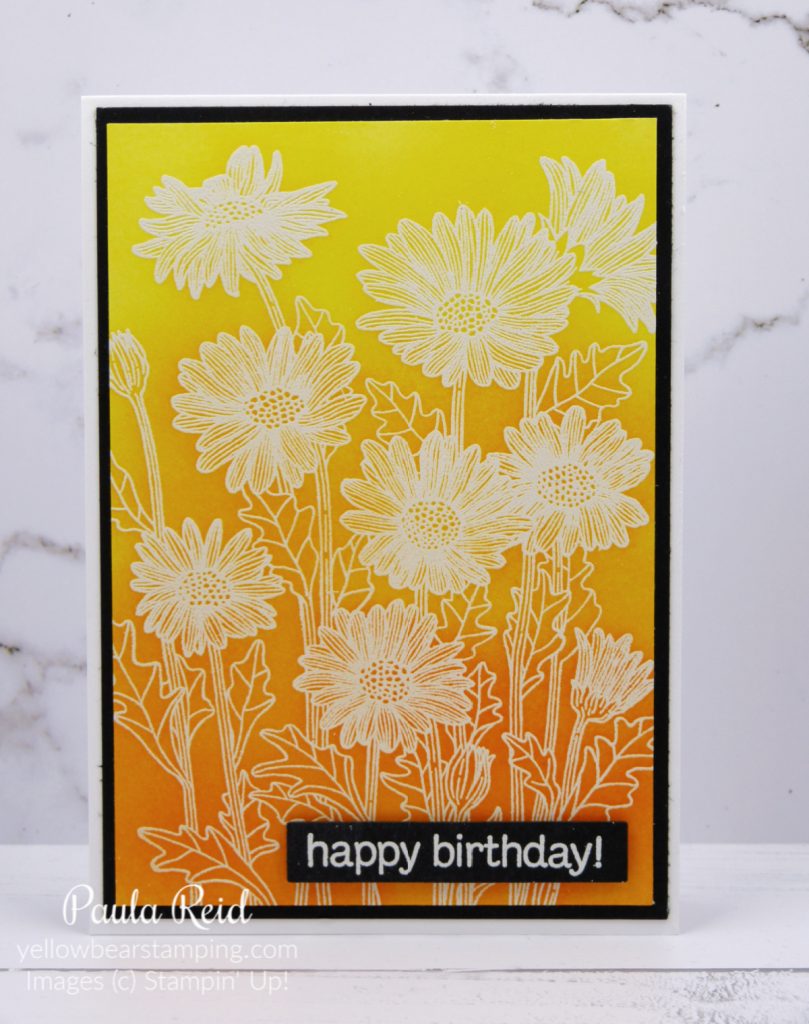
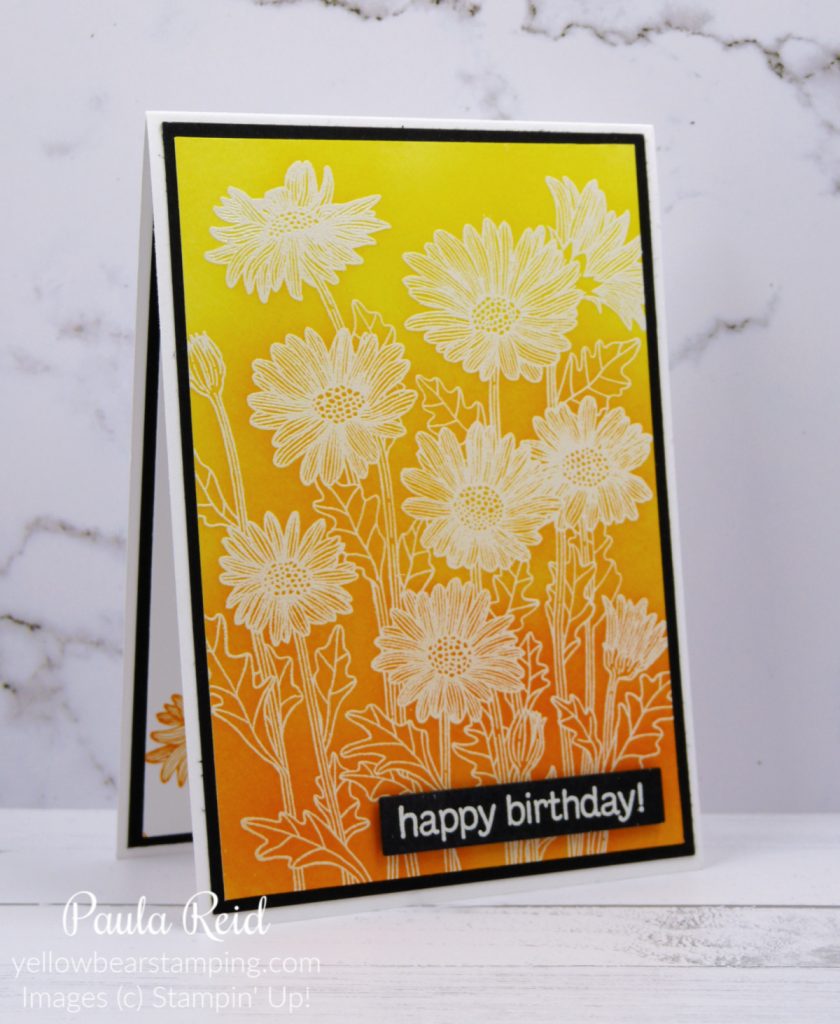
Last month we had an online event for demonstrators in the South Pacific. It was a fun afternoon of crafting together with presentations and some ‘hands on’ crafting. The first presentation was the ‘smooshing’ technique. My first attempt did not turn out well – it ended up in ‘file 13’ – but I was pleased with ‘take 2’.
To create my card I started off with a piece of Shimmery White measuring 8cm x 12cm. I stamped my image – Daisy Garden – with VersaMark and White Embossing Powder. Now the fun begins. You will need either a piece of Window Sheet or some cellophane. I used the cellophane wrapper from a pack of Designer Series Paper.
I ‘swiped’ my Daffodil Delight ink pad (left to right) and then repeated the process with Pumpkin Pie. It doesn’t matter if the colours overlap a bit.
Add a light spritz of water to the inks then place your stamped image face down so that it picks up the ink. I gave it a gentle push all over so that I got good coverage of the ink before lifting it off. I then gave it a bit of a heat with the heat tool on the low setting to dry it a bit.
Once it was dry I trimmed it down using the Stitched Rectangle die and adhered it to my Thick Whisper White card base using Foam Adhesive Strips. I kept with the heat embossing theme for the sentiment as well. I like the contrast of the black cardstock against the Pumpkin Pie. This was adhered with dimensionals. The bow uses White Baker’s Twine from the Baker’s Twine Essentials Pack. This pack contains 5 different colours – Crumb Cake, White, Black, Gray Granite and Very Vanilla.
This technique gives you another alternative for your backgrounds when you don’t want a plain white background. It’s also the type of technique that every time you try it you’ll get a different look. So grab a couple of colours and give it a try.
I have two cards to share today – one landscape and one portrait – featuring the same fun fold to create a Closure Card. I first made this style of card back in January 2019. I CASED it from a card I was given but I think the original design was created by a US demo – Rachel Tessman.
To create the closure the original card used the Classic Label punch which has now retired. I’ve managed to replicate this by using one of the dies from the Tasteful Labels dies – this particular die has become very handy as a replacement for cards that previously used the Word Window Punch or the Classic Label Punch.
The Dragonfly keeps the card closed but if you fold the wings in to the centre as per below, the card will open.
I’ve used the Dragonfly Garden Bundle to create this card – bundles are great for two reasons – your stamp set comes with either a coordinating punch or die set to easily cut out the images and you get to save 10% when buying a bundle.
When I adhered the panel to the front of the card I didn’t let the glue dry before doing my die cutting which meant the die didn’t leave a clean cut – note to self – allow the glue to dry next time. So that the inside looks nice and tidy I added the strip of DSP. The Dragonfly is adhered with Glue Dots. The next card is also CASED from Rachel Tessman.
This card is created in the same way as the previous one. Before I die cut the hole I cut 1/2″ off each side of the front to create the narrower front.
I’ve used another bundle for this card – Butterfly Brilliance Bundle – which comes with a stamp and coordinating dies. The stamp in this bundle is a single stamp with six difference sized and shaped butterflies. The dies consist of one big die to cut all your stamped images in one go and then 6 individual dies to create the overlays plus an additional 5 dies to compliment you projects.
For the inside of this card I added an insert to write the message on which has also been die cut with the stitched effect to give a nice surround to the hole.
The Designer Series Paper (DSP) used on both cards is from the Hand-Penned pack.
Both these sets work really well with this fun way to close your card.
Over the last couple of weeks I’ve shared some different ways for you to use our Gilded Leafing – applying with Tear & Tape and also with Heat & Stick Powder. Today I have another method using our Adhesive Sheets which can be found on page 167 of the Annual Catalogue.
For this card I wanted the overlay for the butterfly to have the Gilded Leafing on it. The Heat & Stick Powder wouldn’t have worked as this is a die and not a stamped image which has been die cut. The Adhesive Sheet works really well with die cut images. I started with a scrap piece of Basic White just bigger than the die. Normally you would adhere the Adhesive Sheet to the back of your image so you can adhere it to your project but this time you want to adhere the sheet to the top. Next, place your die on top and run it through your die cutting machine. Remove the protective sheet and apply the Gilded Leafing patting it down to a smooth finish. Now to create the card base.
Using the second and fourth largest Stitched Rectangle dies create a frame from Basic White. I cut them at the same time. Adhere Foam Adhesive Strips to the back of the frame around the outer and inner edges. My card base is slightly smaller than usual and measures 10.5cm x 14.3cm to accommodate the frame. Before adhering the frame to the base I added my background which is the lovely Fresh Freesia Shimmer Vellum from page 135. The sentiment is from the Turtle Friends set – I love this font – which has been heat embossed in White and die cut using one of the labels from the Pretty Pillowbox dies. Now that the base is complete adhere your Gilded butterfly – I used some of the Foam Adhesive Strips for this.
I hope the last couple of weeks projects have inspired you to try our the Gilded Leafing and also highlighted some of alternative uses of our adhesive range. If you have any questions about these projects please leave me a comment.
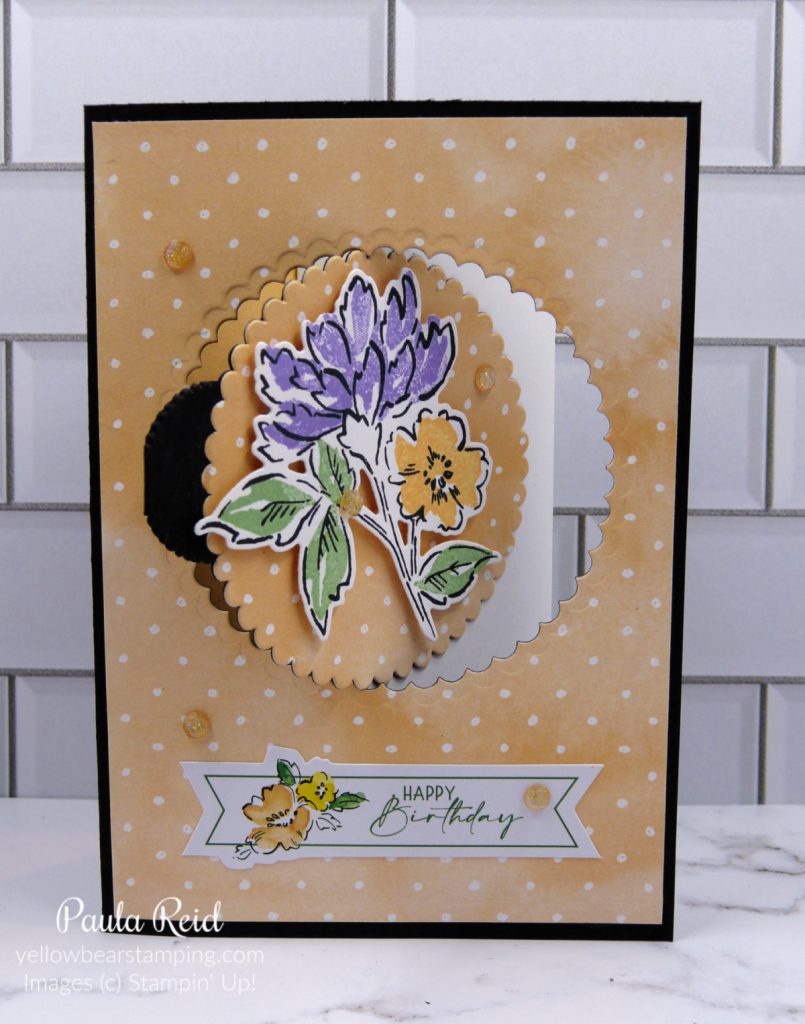
Last Friday I shared a Faux Pocket Card and today I have a ‘real’ Pocket Card to share. I’ve used one of my favourite suites from the Annual Catalogue – Pansy Petals Suite. I love this paper and am now on my second pack of paper.
This card looks similar to the one from last week but keep reading to see the difference.
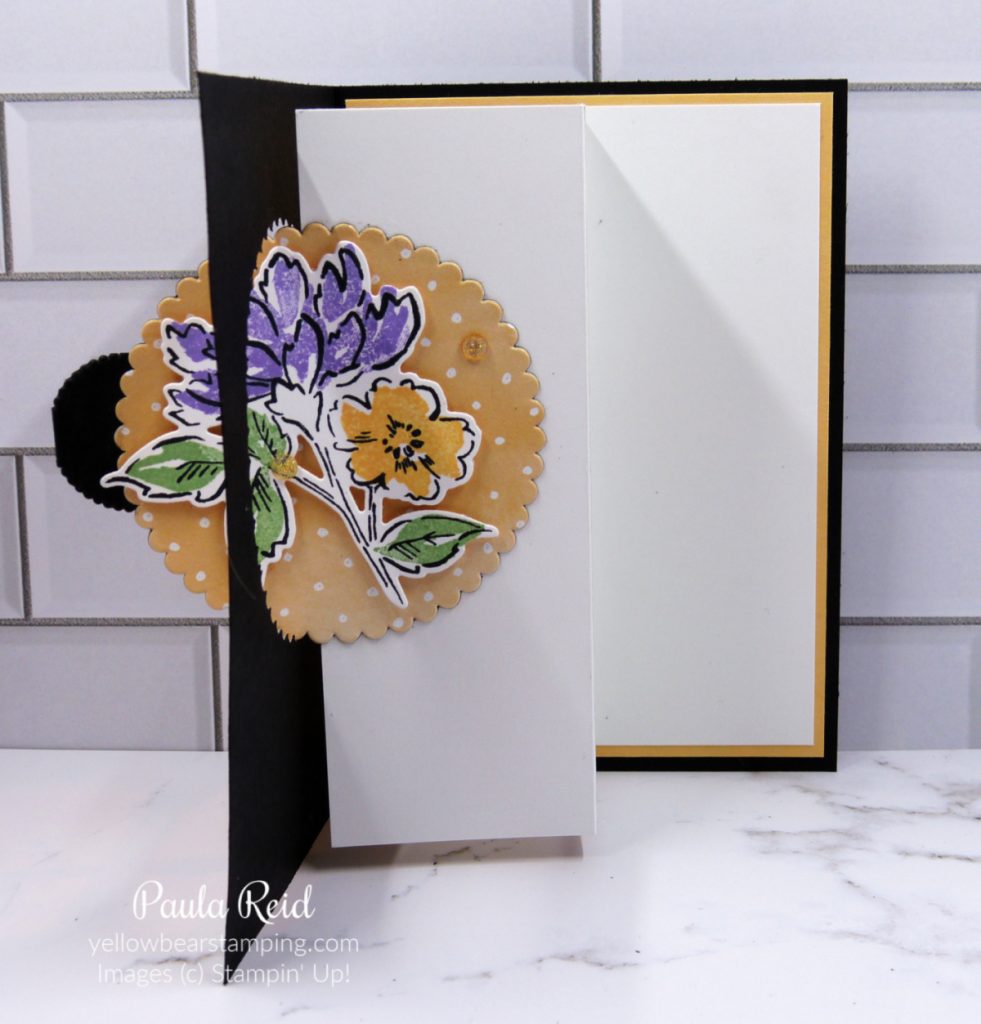
Instead of opening the card you pull the the tab up to reveal the insert. The ‘card’ outer creates a pocket for the insert.
The ‘pocket’ uses a whole sheet of cardstock which has been cut in half lengthwise (10.5cm x 29.7cm) and scored in half at 14.8cm. Taking one piece at a time cut it diagonally from centre top to bottom left and then the next piece centre top to bottom right. Adhere both ‘rectangle’ sections together making sure that the long edges of the diagonal sections are on the bottom. Decorate the diagonal sections with Designer Series Paper (10cm x 14.3cm – cut in half on the diagonal). Before you ‘criss cross’ your pocket shut apply Tear & Tape at the bottom of the middle section as well as at the bottom of the triangle flap that will be the top layer – for my card the top layer was the left hand flap.
To decorate the front of my pocket I used a Scalloped Rectangle die from the Scalloped Contours set and added a die cut Pansy and leaves from some of the DSP designs. I also carried it through to the insert – this time using some darker leaves. The sentiment on the front and inside of the card are from the Pansy Patch set. The insert measures 9cm x 13.8cm for the Basic White and 9.5cm x 14.3cm for the Calypso Coral mat. For my ‘tab’ I die cut two ‘eyelets’ from the Tailor Made Tags die set and adhered them either side of the insert.
You now have two variations of Pocket Cards to create – which one will you try first?
I have another project using the Gilded Leafing and this time we’re combining it with the Heat & Stick Powder from page 167. This is the ‘go to’ page for all the different types of adhesives.
For this card the Gilded Leafing gives a similar effect as heat embossing. I’ve used the Painted Poppies stamp set which is a ‘two-step’ stamp and stamped the solid image in Poppy Parade. Next ink up the outline stamp with VersaMark and stamp onto of the solid image. Apply the Heat & Stick Powder as you would embossing powder and heat until the powder turns to liquid – don’t overheat. Now you’re ready to apply the Gilded Leafing. As my stamped images are small I was able to put them upside down in my container so that the leafing adhered directly to the Heat & Stick. If you have a larger image you will need to place pieces of the leafing on top of the Heat & Stick and gentle push them together to adhere.
This angle gives you a better look at the Gilded Leafing effect. The gold leafing is more ‘sparkly’ than gold heat embossing. The leafing works well on any ‘two step’ stamp like Art Gallery or Hand-Penned Petals.
This card has another technique – have you spotted it? We don’t have any Poppy Parade ribbon so I coloured a length of the White Crinkle Seam Binding Ribbon with my Stampin’ Blends, left it to dry for a bit then adhered a length to the card front before tying a bow. This ribbon is a ‘go to’ one as you can colour it any number of colours to coordinate with your projects.
Check back again next week to see how I use the Gilded Leafing with Adhesive Sheets.